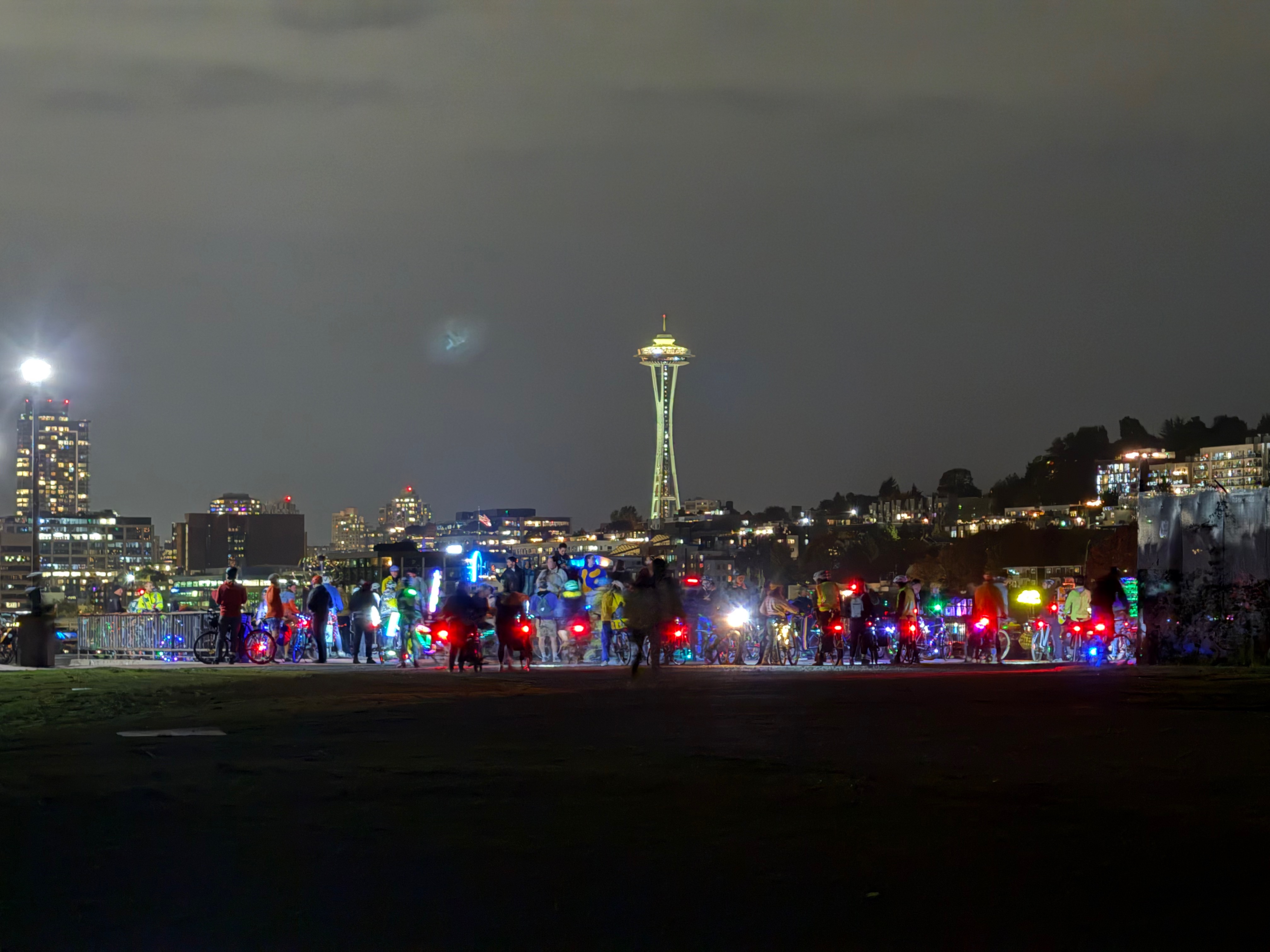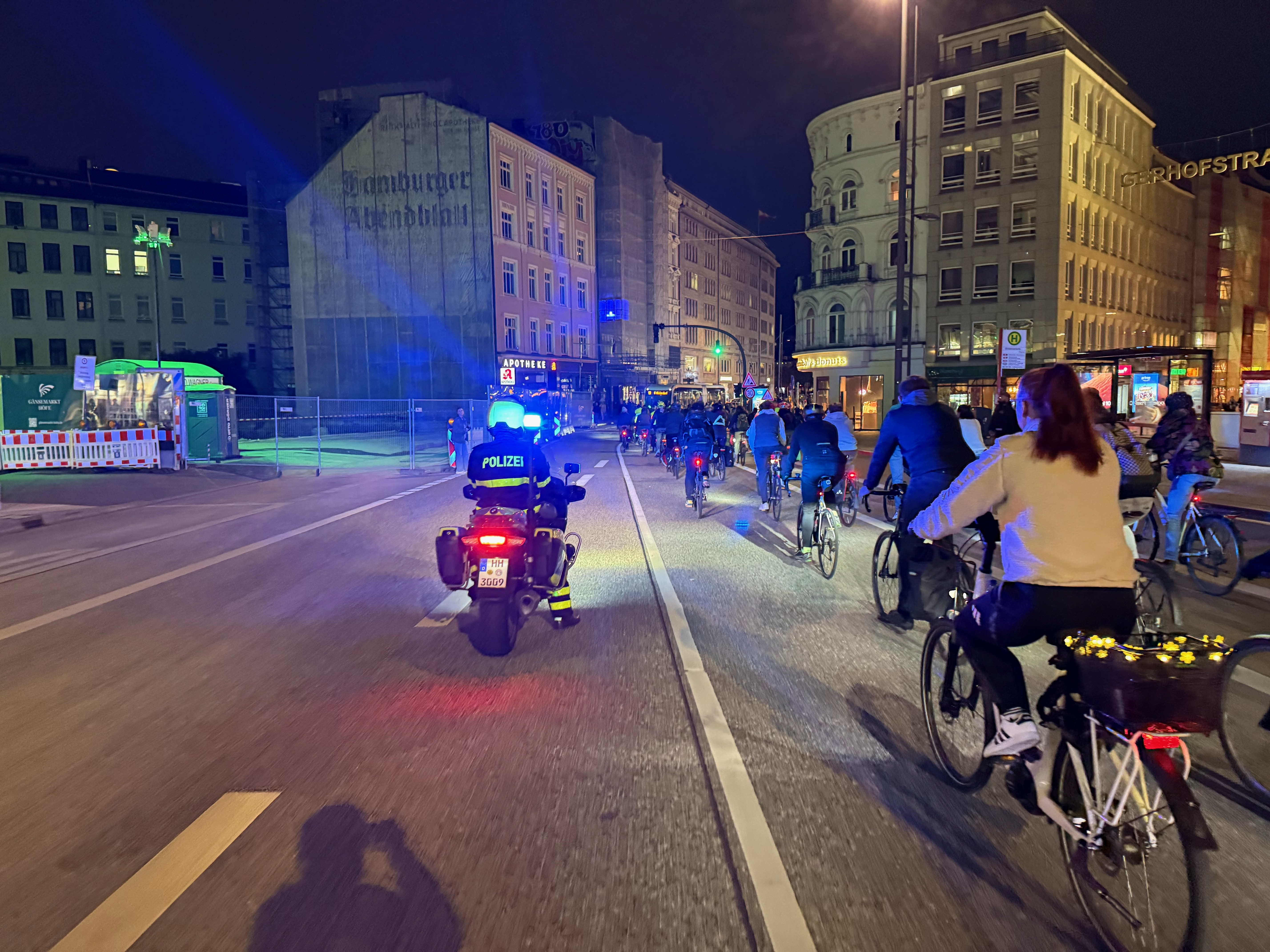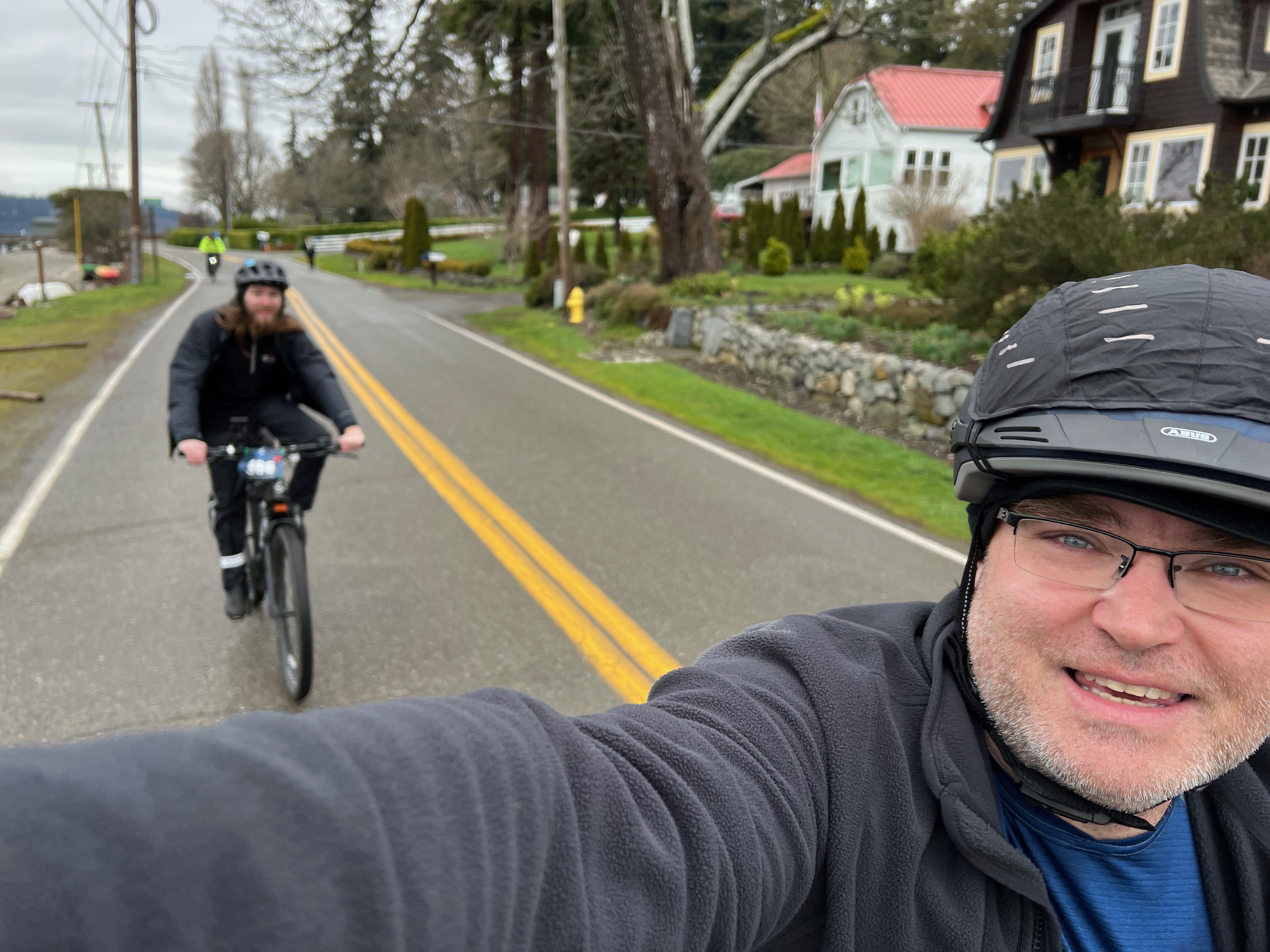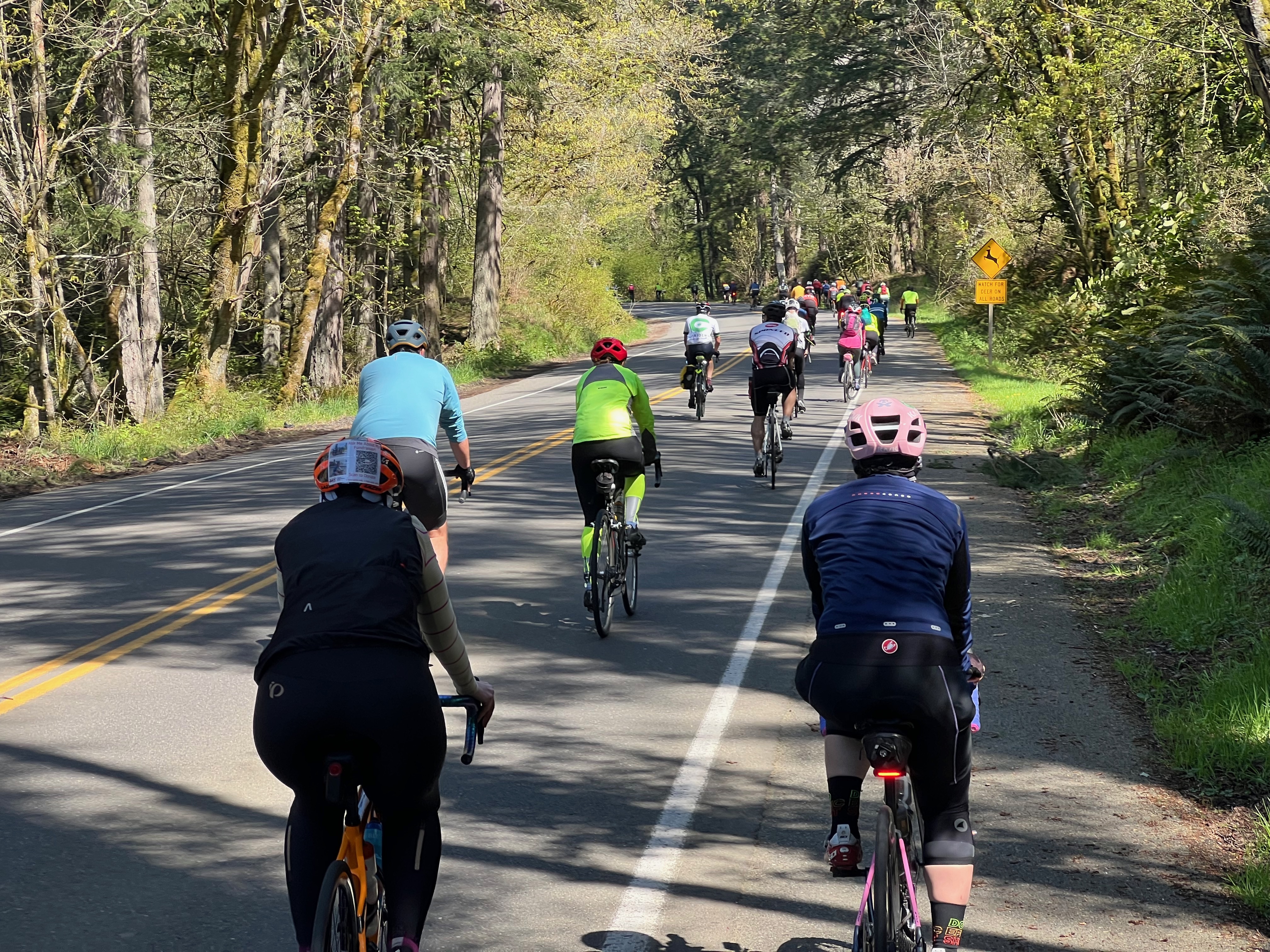
Keeping the ride safe: Lessons from Seattle group bike rides

So you want to run a group ride?

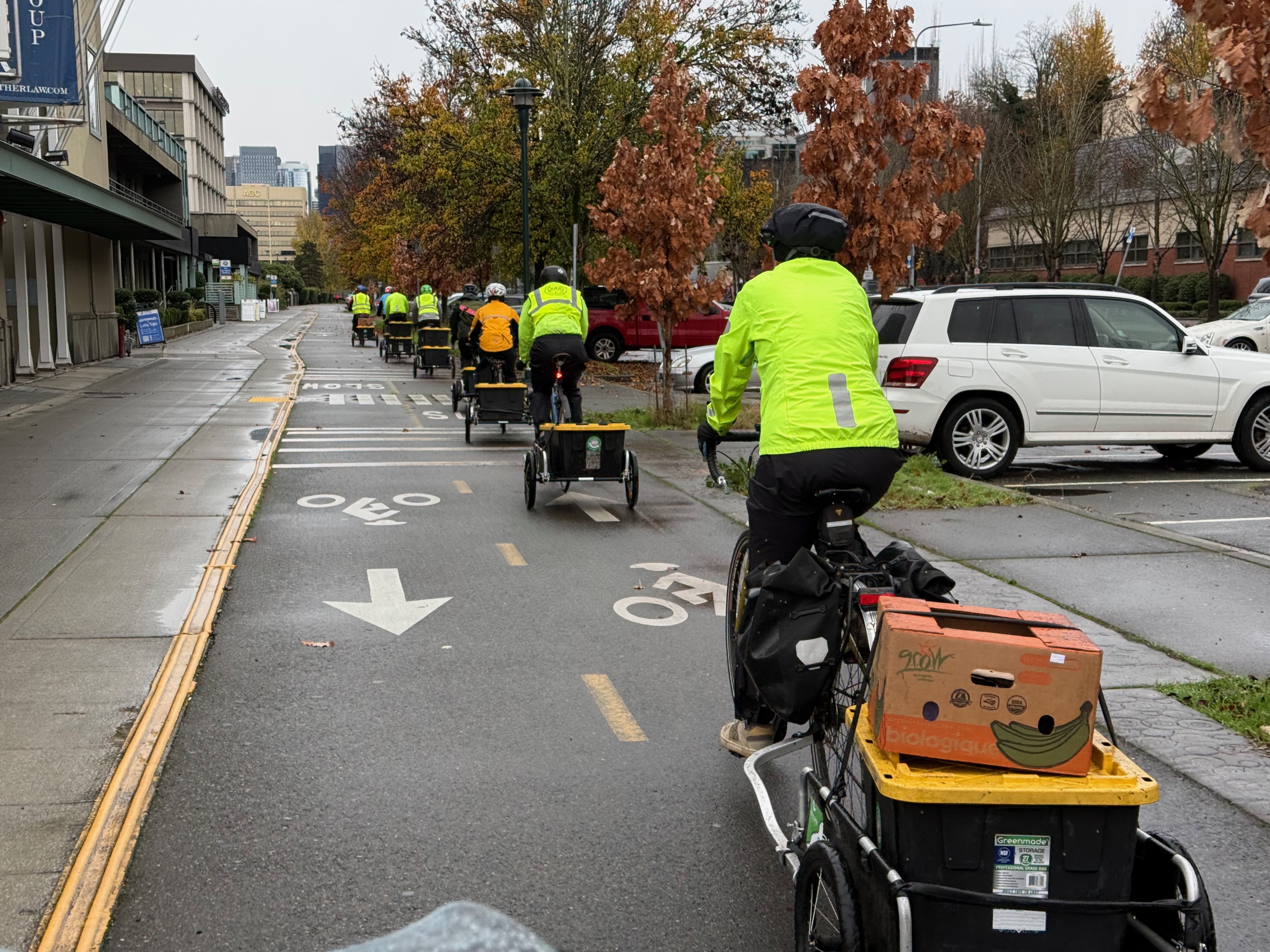
Group bike rides are one of the most fun ways to explore a city with your friends, or just to spend a few hours or a day out. Joining organized group rides such as Critical Mass in your city is a great way to meet like-minded people and see new parts of the city. But… how do you get dozens or hundreds of people around safely? The main threats in a group bike ride are:

  1. Cars. There is no question, cars and their drivers pose the most risk to everyone getting home safely. Most of this post covers how to keep the ride safe from cars and how to safely navigate wide streets and large intersections.
  2. Environment. Potholes, curbs, puddles, overhanging vegetation, bollards, poles, broken glass, etc., everything is out to get you. Communication is key.
  3. Riders. Try not to run into each other, and communicate clearly where you’re going. Don’t assume someone knows you’re there.
  4. Bikes. Riders may get flat tires, break a chain, drop a chain, get a strap caught in a cassette, fail to clip out, and any number of other bike-related problems. Be prepared for the basics, communicate dangers, and be ready to help when someone gets in trouble.

I’ve ridden with group rides from just a few people up to thousands, in several different cities and countries, and there are a few things that help any ride run smoothly, and dangers in common. Whether you’re leading a group ride or just want to join one, hopefully this post provides some useful information for you.

Overview

  • Come up with a cool idea for a group ride; not too long, but also not too short, appropriate to the riders’ skill level and strength, and interesting.
  • Ensure you have sufficient facilitators for the quantity of riders expected and that facilitators understand and correctly perform their roles.
  • Decide what kind of ride you want, considering the number of riders: bike facilities only, single lane only, or full takeover. (See definitions and examples below.)
  • Have a ride leader: a single distinctive, bold, and well-prepared leader to set the direction and pace, keep the group together, and direct other facilitators.
  • Have corkers: a number of riders that control traffic effectively and keep cars from presenting unsafe situations.
  • Have a caboose/sweeper: a rider that marks the end of the group, and ensures no one is left behind.
  • Have communication: use radios or another real-time communication mechanism between the ride facilitators to communicate the position of the caboose/sweeper, any problems (such as mechanicals) and any dangers (such as aggressive car drivers).

Facilitator roles in a group ride

Let’s take a look at the different roles in a group ride. Some should always exist, such as leader, while others may be optional.

Leader

  • Be the single leader who is in charge, knows the route, and makes decisions (sometimes on-the-fly) about where to take the group.
  • Maintain a reasonable/slow speed to not stretch the group out too much, usually 8-10 mph (“party pace”); slower if there are hills or inexperienced riders.
  • Don’t lead the group ahead of corkers; let them get in place ahead of you when possible, and ensure that traffic is controlled at each intersection before proceeding.
  • Communicate to the corkers and first few layers of the group by making a few callouts:
    • Expectations: “rolling after these three cars from the left”, “stopping to regroup”, etc. so that those riders can make callouts to those behind, and so they don’t make confusing callouts (such as misinterpreting a corker getting into place and calling out “right turn” when the group is going straight) or even misunderstand and go the wrong way.
    • Actions: “rolling”, “stopping”, “slowing”, etc.
    • Directions: “left turn”, “right turn”, “straight ahead”, “hard right”, “left turn into the bike lane”, etc.
    • Needs: “someone cork the left side”, “help with that car ahead”, etc.
    • Dangers: car, pedestrian, bollard, hole, gravel, curb, etc.
  • If a planned turn is missed, don’t panic! It’s probably not safe to make “small” maneuvers to correct back, as a large group has a lot of inertia. Instead it usually makes more sense to take the whole group through a parking lot or around a block, eventually re-joining the route where possible. If a U-turn is necessary, ensure there is enough space to get the whole group into a safe position, and encourage everyone to follow the leader rather than shortcutting the U-turn.

Corker/Marshall

  • Corking is often a volunteer role at the time of the ride, and some people may choose to cork only some of the time.
  • Anyone can cork at any time, and people should be encouraged to cork if they see anything that may present a safety issue for the ride (for instance, a previously unoccupied car that a driver gets in and intends to pull out into the street).
  • Control (primarily) car traffic ahead of, and through the ride, to keep cars from entering, crossing, or endangering the ride.
  • It may be necessary to control bike or pedestrian traffic at busy intersections. Since they are humans you’re face to face with, be polite and communicate what you’re doing, and set expectations for how long you will take.
  • At least 2-3 corkers are needed for most groups; for larger groups and/or larger intersections, 10 or more could be needed.
  • Corkers should normally stay in place until the caboose passes, and if desired, ride fast and catch back up to the leader and continue corking at another spot.
  • It may be necessary to help out the caboose to provide some “mass” at the rear if they are being harassed or intimidated by cars behind the ride.
  • Ask for help from other corkers and riders if a situation becomes unsafe or uncomfortable to provide more mass.
  • Ask for help from other corkers and riders if you notice that cars/movements are uncontrolled (e.g. a traffic lane that was left uncorked inadvertently).

Patch/Medic

  • A person familiar with bikes and typical problems and repairs and/or first aid, a quick thinker and willing to jump in to help with any problem. (Any individual could be a patch, medic, or both. Often they are bike mechanics or people who have taken first aid classes.)
  • Carry tools, possibly some spare parts, first aid kit, snacks, water, etc.
  • Help with any problems (“mechanicals”) riders encounter and get the ride rolling again as soon and as safely as possible.
  • The most common problem is a flat tire due to a puncture, so the most basic thing to carry is inner tube patches or spare tubes, a bike pump, and some basic tools.

Sweeper/Caboose

  • Stay at the back of the ride and represent the official “end” of the group.
  • Don’t leave anyone behind unless they ask to be left (and really mean it).
  • Signal or communicate to the corkers as you go by (and/or be distinctive enough for them to immediately recognize you) to release them from corking.
  • Block or recruit others to block cars from attempting to pass the ride unsafely in the center turning lane or oncoming traffic lane to defend the riders ahead.
  • If radios or other communication devices are used, communicate the position of the end of the ride to the leader, ask for delay or slower pace, and communicate any problems or stalls.

Rider

  • Have fun! Don’t worry about the mechanics of a group ride too much.
  • Bring the very basics of self-support: headlight and tail light if the ride (or your ride to/from it) will be after dark, spare tube, tools appropriate to your bike, pump, water, etc., and bring a transit card/pass as a backup way to get home.
  • Play music. Dress up. Decorate your bike. Have a ton of lights. Be yourself.
  • Follow directions and keep rolling unless the leader stops or says to stop.
  • Don’t ride in front of the leader or behind the caboose. If you do, you’re no longer part of the ride and you’re on your own.
  • Communicate your intentions (on your left, on your right, slowing, stopping, ding your bell, etc.) to the other riders near you. Don’t surprise anyone.
  • Call out and/or point out dangers to fellow riders, such as bollards, holes, gravel, curbs, etc.
  • Repeat messages and warnings to riders behind/ahead of you.
  • Keep an eye on your fellow riders and their bikes, let them know of anything unsafe or developing, such as a strap hanging in their wheel, tire going flat, items dropped, cars, car doors, etc.
  • Ride safely. Ride dangerously. Ride boldly.

Call-and-repeat messages (callouts)

As the ride proceeds, the riders and facilitators must communicate constantly. There are a number of things that can be called out such as “car back” or “bike up”. Each of these messages should be repeated by riders (using their own discretion) to ensure the message is passed forward/backward through the group. Anyone with radios should also make the same call over the radio as appropriate.

Defining positions in callouts

up: ahead of the ride, approaching from ahead (moving or stationary)

back: behind the ride, approaching from behind

right/left: relative to the path of the ride (or ride leader) not necessarily the person calling

Specific callouts

car [up/back]

A car is approaching (or being approached) from ahead or behind in a way that riders should be aware of.

Typically “car up” calls alert riders to stay on the correct side of the road, and to be more careful with any shenanigans such as wheelies.

Typically “car back” calls alert riders that a car is passing the group, either in the opposite direction lane, or in an open lane. A “car back” call could be urgent if the car is acting very aggressively towards the group, speeding to pass, etc.

Sometimes it’s helpful to call “car back, passing” to let the riders ahead know that the car is already passing and approaching them.

bike [up/back]

Same basic idea as a car, but a bike. For “bike up”, mostly a heads up for nobody to run into a bike in the opposite direction (or slowly riding in the same direction). For “bike back” mostly to be aware that they might be passing. Sometimes helpful to call “bike back, passing”.

It can be helpful to say “bike up, on the right”, for instance, if the position of the bike is unexpected or otherwise helpful to other riders to know.

pedestrian/ped up

A pedestrian is ahead, and typically the group should try to yield some space to them to get where they are going (such as crossing the street), or at minimum avoid hitting them. Often it’s useful to say “ped up, on the right” or “ped up, on the left” or even “ped up, both sides”; pedestrians are wily creatures.

broken/together

It’s common in some group rides, especially when not using corking to manage traffic and proceed through intersections at a group to call out when the group is split. Call “broken” whenever the ride is split, usually by a traffic signal. Call “together” when the group is all back together. The ride leader will sometimes wait in a safe place to regroup after a “broken” call, unless it was discussed beforehand that there would be designated regroup points.

mass up

In large rides, especially Critical Mass, a call of “mass up” requests for the front of the group to slow down and allow the group to gather more tightly together.

mechanical

Sometimes described as an “emergency stop” – after a “mechanical” is called, the ride leader will make a decision to “pull over” the ride in a safe place. Individual riders should not pull over on their own, instead just following the ride leader after making sure that they have gotten the message.

Planning a successful and safe route

  • Use a route planning tool such as Ride with GPS to put together a safe route and use a device to follow the route on the actual ride. Google Maps and Apple Maps are not suitable for route planning or for use during the ride because they will readily re-route you during the ride, which may send the group on an untested and unintended (and often unsafe) route. (They can still be used to supplement an appropriate route planning tool.)
  • A few days before the planned ride, pre-ride the route with similar conditions as there will be on the actual ride: ideally on a bike, with a small group, at a similar pace, at a similar time of day, if possible on the same day of the week. This helps avoid surprises during the ride such as hills that are too steep, traffic that is unsafe, unexpected lighting issues, etc.
  • When the ride uses busy roads with more car traffic, it can be useful to include a pressure relief in the plan. Take the ride on a U-turn on a side street, or turn off the busy street for one block and back on it, loop through a parking lot, or even a make a brief stop on a large shoulder or parking lane. It’s better to be creative and include something fun and less obviously for pleasing car drivers, such as making a quick loop through a nice park near the intended route… then car pressure from behind is relieved, and the riders are just having fun.
  • When the ride crosses streets, try to ensure good visibility by crossing in a relatively flat/straight section away from bends and hill crests that limit visibility.
  • When crossing at an intersection in the lane, press the pedestrian crossing button, which often gives the signal phase more time than if it’s signaled only for cars.
  • Avoid left turns from busy roads (especially multi-lane roads), especially without a good number of well-prepared corkers. Left turns that are yield-only are some of the worst.

Strategies for how and where to ride

Bike infrastructure only

Strategy

  • Use only bike lanes, paths/trails, and pedestrian infrastructure (as allowed/safe).
  • Sometimes use Single lane only strategy where no bike infrastructure exists.

Pro

  • Least likely to draw negative attention from drivers or police (but still, it turns out, not zero).
  • With small groups, this strategy can make for a more relaxed ride.

Con

  • Bike infrastructure as designed in the US is not suitable for moving a large number of bikes as a group. The signal timings in any intersection will break the group into many small groups.
  • Stopping and starting the group rolling at each intersection takes a lot of time.
  • Regrouping once the group has been split up (broken) will take significant time and only allow the group to move at a very slow pace (something like 1-3 mph average) spending most of the time waiting to regroup.
  • Uncomfortable for riders who are left as the “leader” in the front of a sub-group when the group gets inadvertently split up.
  • Riders may be inclined to perform unsafe or illegal maneuvers to avoid being left behind, such as running a red light or stop sign as a single rider, without any traffic management.
  • Other users of bicycle and pedestrian facilities may be blocked by or unable to navigate through or across the group, or may be tempted to do so unsafely.

Single lane only

Strategy

  • Occupy a single traffic lane and act as one big vehicle or train.
  • Sometimes use Full takeover strategy if an area or intersection is too unsafe to guide the group through with mixed traffic (e.g. to make a left turn), or if a situation becomes unsafe.

Pro

  • Fewer (but not zero) conflicts with car drivers than a full takeover.
  • Less likely (but not zero) to draw negative police attention.
  • A full traffic lane packed with bikes (4-5 wide when stopped) fits a lot of bikes in a small space and allows effective movement through intersections given car traffic signal timings.

Con

  • It can be very difficult to safely change lanes with the group, e.g. to turn left from a multi-lane road. Strategies exist but require good coordination between the leader at the front and the sweeper at the back.
  • Some car drivers will still be upset, especially when a right turn on red is blocked by the group.
  • Without corking, if the group doesn’t make it through an intersection in a single signal, the group will be broken up, and then mixed into traffic in a very dangerous way. (Consider asking the group to continue through each intersection as a group.)

Full takeover

Strategy

  • Occupy all lanes in the direction of travel to prevent cars from passing or mixing with the group.
  • Occupy the center turning lane when present to keep cars from passing unsafely.
  • Occupy the curb parking lane when present to keep cars from passing unsafely.
  • Occupy the opposite direction lane when there is no separation (e.g. a median) and there are no oncoming cars to keep cars from passing unsafely.
  • Cork every intersection ahead of the group and keep them corked until the group passes through (the caboose should release the corkers explicitly).

Pro

  • The safest option for large groups (especially 100+) to move efficiently and safely.
  • Corking is very clear and unambiguous: all conflicting cars stop for the group to pass through.

Con

  • Requires many corkers, especially if large or complex intersections (e.g. freeway offramps) are traversed. (However if this is the case, you should definitely really consider using this strategy for safety reasons, anyway.)
  • Causes the most conflicts with car drivers.
  • Likely to draw police attention and possible attempts to disburse the group, and in the worst case arrests.

Legality

Laws and the enforcement thereof vary from place to place. In Seattle, large group rides are quite common, and in recent years are subject to almost no police interference or enforcement. In other locations, you could see anything from no interference to an almost immediate police presence and possible arrest of participants.

Examples from Seattle

Critical Mass Seattle

  • Protest ride, intended to draw attention and disrupt
  • Size: Up to ~250
  • Strategy: Full takeover
  • Planning: Start point known, but no planned route
  • Roles:
    • Leader – sometimes informal, often without pre-planned route
    • Corker – informal, directed on-the-fly by leader or by own initiative
    • Patch/Medic – usually informal
    • Sweeper/Caboose – sometimes semi-formal, sometimes none
    • Rider – informal, join and leave as desired
  • Communication: Radios handed out to a few key people before the ride

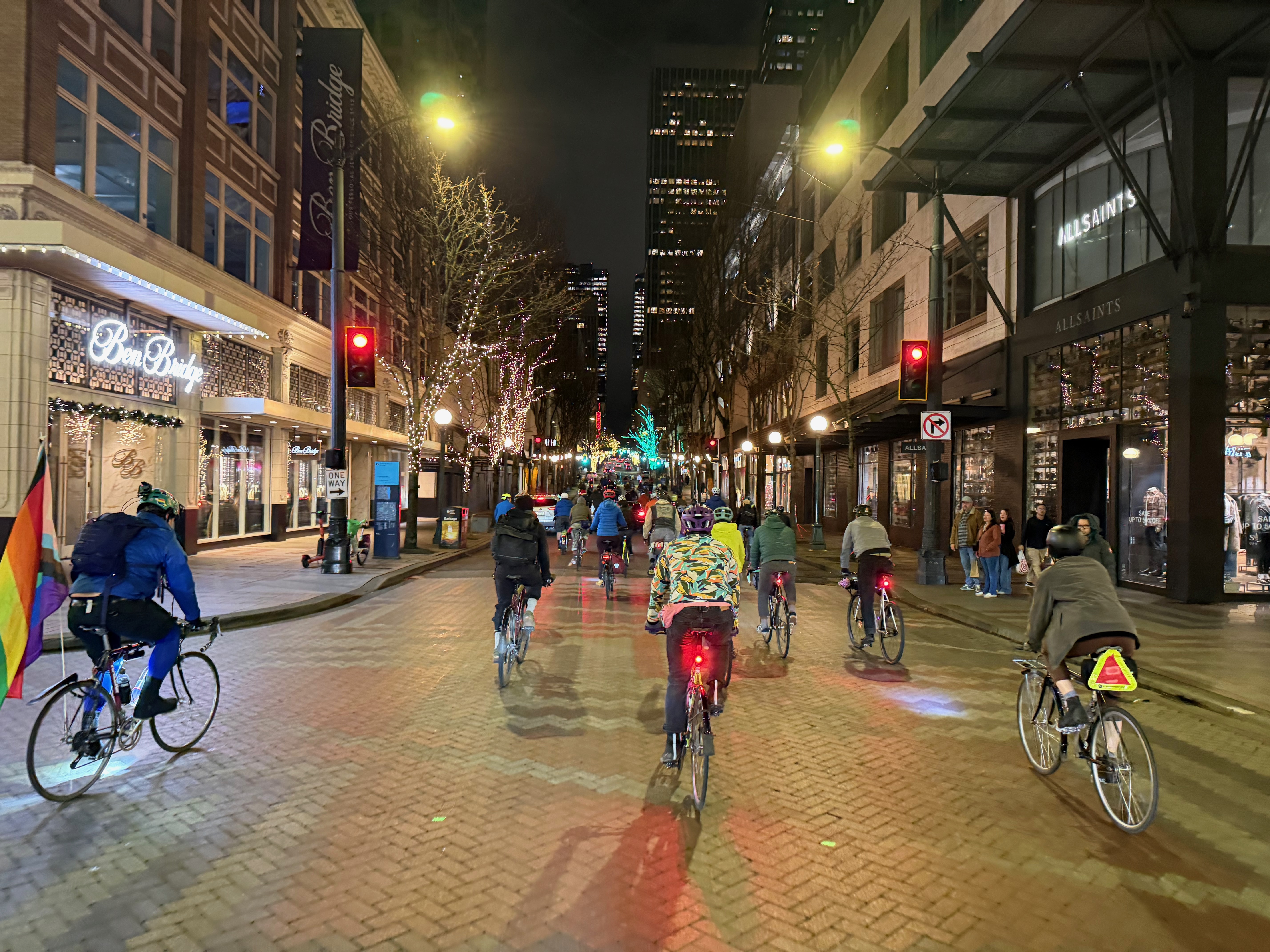
Seattle Bike Disco

  • Fun ride, intended to be joyful and minimally disruptive
  • Size: Up to ~250
  • Strategy:
    • Single lane only (usually)
    • Full takeover (sometimes)
  • Planning: Pre-planned route, pre-ridden, all facilitators have route.
  • Roles:
    • Leader – always formal, with researched and tested route
    • Corker – informal, directed on-the-fly by leader or by own initiative
    • Patch/Medic – usually formal, announced pre-ride
    • Sweeper/Caboose – usually formal, with route knowledge
    • Rider – informal, join and leave as desired
  • Communication: Radios brought by ride facilitators

Cascade Bicycle Club (free group rides)

  • Group rides for tours, education, or fitness
  • Size: Up to ~25
  • Strategy:
    • Bike facilities only (usually)
    • Single lane only (sometimes)
  • Planning: Pre-planned route, usually pre-ridden, shared with all riders
  • Roles:
    • Leader – always formal, with researched and tested route, educational and certification process for ride leaders
    • Corker – usually not used due to strategy, sometimes not allowed
    • Patch/Medic – sometimes none, sometimes the Leader, sometimes formal
    • Sweeper/Caboose – usually formal, with route knowledge
    • Rider – usually formal, pre-ride signup
  • Communication: Usually voice, relatively small groups

Duwamish Trail Cleanup – Saturday, December 7, 2024

Who?

You! Anyone can help if you can spend a bit of time and muscle power. Whether you like to bike, walk, or just happen to drive by the trail and see others using it, or have never even seen it and want to make Seattle a better place – come on out! We can provide tools (but bring whatever you’ve got that seems appropriate and you don’t mind using, even better if you can share some tools). I’ll centrally collect the litter bags afterwards. We’ll figure out the vegetation disposal. We just need you!

When?

Saturday, December 7, 2024 from 9am to noon and 1pm to 3pm, but your time commitment is flexible, feel free to come and go when you can, but here’s the plan:

  • 9am – meet at Herring’s House Park, choose and fan out to different work areas
  • 9am to noon – work independently or in teams, do what needs to be done!
  • noonish to ~1pm – meet back at the park for a bit of socialization and snacks, eat whatever food people choose to bring, share war stories, discuss ideas for future cleanups, rant about winter, etc., feel free to stay as long as you like, it’s a public park!
  • ~1pm to ~3pm – anyone who wants to go back out, centrally collect litter bags (by bike + trailer), do touch ups, etc. as needed, if you’re able!

Where? How do I get there?

Meet at Herring’s House Park on the Duwamish Trail.

Biking to the park is, of course, the best option, and allows you to easily get to other parts of the trail as needed. Bring a bike trailer if you’ve got one!

Bike or scooter share (Lime, Bird, etc.) is also a great option to get there if you don’t have your own bike, since you can use it to get elsewhere along the trail, or leave it at the park to get back afterwards.

Unfortunately, public transit is a big challenge (or impossibility!) for this location. The closest you can get to the park is more than a mile away, Bus 125, RapidRide H, Bus 21 all stop at the north end (Delridge, Chelan). Bus 131 stops at the south end (Highland Park Way). We can probably organize some carpools if needed (just ask!), but maybe bike/scooter share the last mile is better!

There is a small amount of car parking at Herring’s House Park (~12 spaces, but often half full already) if you need, otherwise park elsewhere nearby (legally!) and walk to the park.

Please do not drive on or park anywhere on the trail itself (or alongside it, with limited exceptions)!

What?

The Duwamish Trail, W Marginal Way SW bike lane and sidewalk, and connections from from Alki Trail (Chelan Cafe) down to the 1st Ave S Bridge. There are a few major concerns, depending on the area:

  1. Litter pickup. Many sections of the Duwamish Trail are a mess and need a full litter sweep and collection of other detritus (e.g. car parts). I last completed a litter sweep (on my own) about a year ago.
  2. Leaf removal. Sections of bike path (and sidewalk especially!) need leaves, sticks, branches, etc. cleared.
  3. Vegetation cutback. Sections or the trail bordered by vegetation from planting strips and fence lines need vegetation trimmed back, especially from blackberry vines. It’s best to trim aggressively (or remove completely) so they don’t just grow back into the path within weeks.
  4. Reporting of issues. Use the Find It Fix It app to report any problems, or anything too big for us to handle, for example potholes/heaves, downed signs, manhole covers open, larger furniture dumped, etc.
  5. Anything you want! If you have other ideas or requests (even if you can’t join) please reach out to me at jeremy@jcole.us and we’ll see if we can do it.

Here are a few examples of what the trail looks like today:

Encroachment on the path:

Face grabbing vines:

Shin-grabbing vines:

Narrowing of the path by overgrowth and leaf matter:

Litter just everywhere:

Because of the linear length of this path (about 3 miles!), it’s a challenge to clean up, and I’d love to organize regular work parties to do it with me. It should probably be done quarterly, ideally. Consider this the inaugural!

Why?

The Duwamish Trail is a major bike and walking/rolling connection north-south on the west side of the Duwamish Waterway/River in West Seattle, and sees moderate recreational and commuting bike traffic. It also serves as a necessary detour for the Spokane Street swing bridge connecting people outside of cars to the 1st Ave S bridge. Aside from its active transportation utility, Herring’s House Park, həʔapus Village Park & Shoreline Habitat, Kellogg Island, and the Duwamish Longhouse and Cultural Center are important culturally and historically to Seattle. It deserves to be nice!

Okay! I’m in!

Awesome. Please RSVP using this Google form so I have an idea who’s coming and what they want to do – it’s not required, but I’d love to get an idea. If you want to play a bigger part in making this even happen, reach out to me by email at jeremy@jcole.us.

See you there!

One year on the Giant Explore E+ 2 with a Rohloff Speedhub 500/14

My bike in my usual Adopt-a-Street work configuration, towing a trailer loaded with tools and supplies, and often bags of litter.

I thought since it’s been exactly a year since I upgraded my Giant Explore E+ to a Rohloff Speedhub 500/14 internal gear hub, that it’s a good time for an update. As for stats: I have put 5,180+ miles on this bike since the conversion.

A custom 3D-printed speed sensor mount

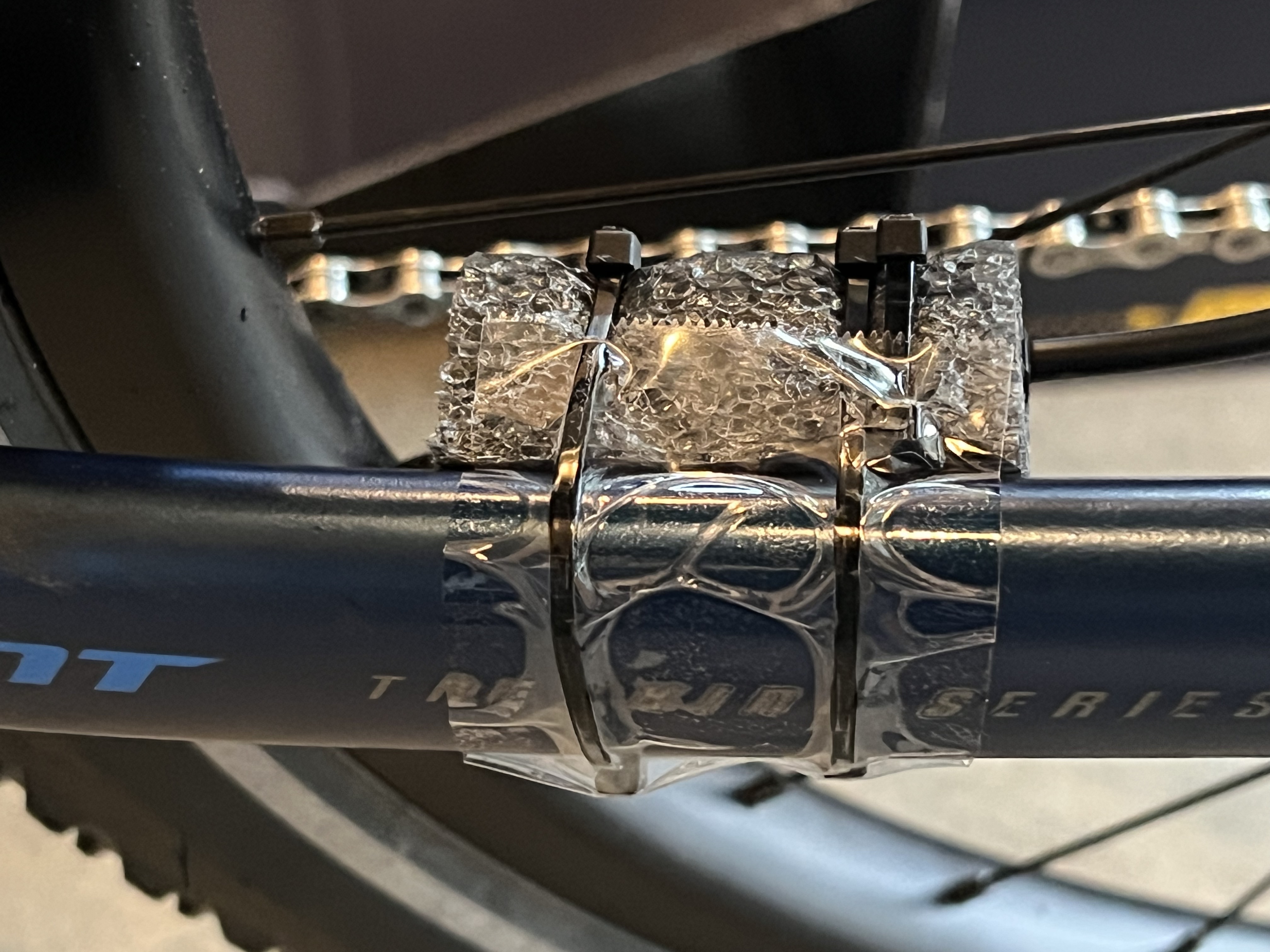
One of the items left unfinished with my initial upgrade to the Rohloff was mounting the speed sensor, which I initially left attached using a hand-cut piece of foam, some zip ties, and some tape:

Speed sensor mounted on a bit of foam with zip ties, held in place with tape just to keep it from sliding on the chainstay.

I initially intended to make a custom mount for it with my 3D printer, and recently got the 3D printer out of storage and set it up, modeled the part, and made it. It’s held on with (beefier) zip ties and double sided adhesive foam mounting tape. It looks great and is working very nicely, no longer getting shifted and out of line with the spoke magnet:

Speed sensor mounted on custom 3D-printed mount, zip tied and mounted with foam tape to the chainstay.

First failure: Worn Rohloff input sprocket

After several thousand miles, I noticed the chain was “skipping” under load, and after swapping chains it was still occurring. I took things apart and noticed that the input sprocket to the Rohloff was fairly worn. I put the bike through a lot towing heavy trailers up big hills, so I am not too surprised by this:

Rohloff input sprocket with worn teeth, stretched out from the original profile and marred.

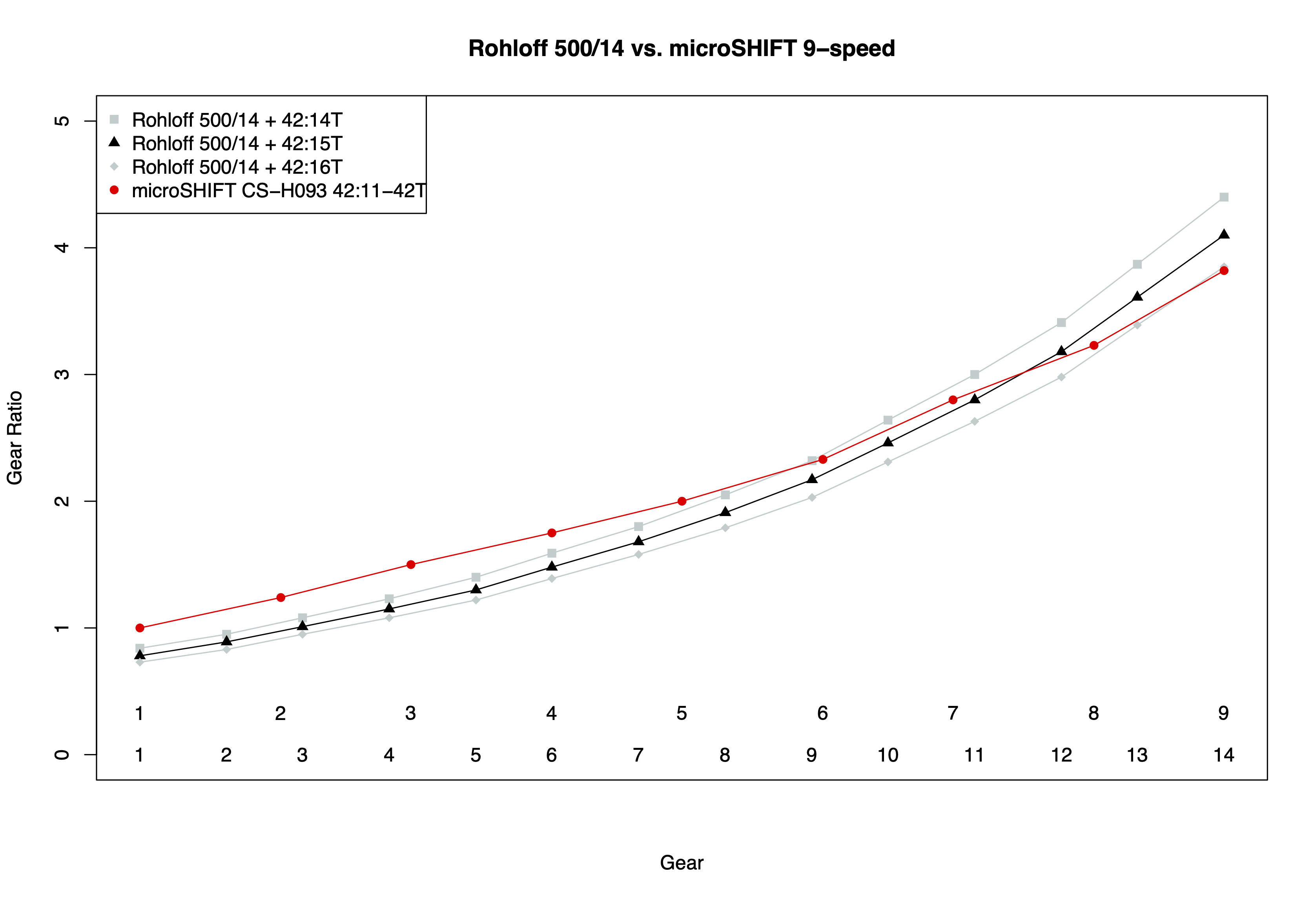
This was a 14T sprocket, and I already had 15T and 16T sprockets on hand, so I decided to install a 15T sprocket instead, as I could use the even-lower gearing and didn’t need all the top-end in high gear. You can see the comparison between sprockets here:

Graph of gear ratios of Rohloff 500/14 with 14-, 15-, and 16-tooth input sprockets compared to the stock microSHIFT drivetrain gear ratios.

The swap completely resolved the skipping issues, and I am really liking the even-lower low gear.

Second failure: Cracks in the Velocity Cliffhanger rim

The biggest failure I had was a failure of the rim at 4,400 miles, with many spoke holes cracking, enough to ultimately lose all spoke tension:

Close up of the rim with a crack extending on each side of the spoke hole.

I ended up rebuilding the wheel (at home this time) on another new Cliffhanger rim identical to the first.

Wheel in process of being taken apart, with most spokes de-installed and flopping about.

What remains to be done

Not much, really! I still haven’t bothered to shorten the shifter cables, but doing so would probably make shifting a little easier by reducing friction. I’ll probably do that soon.

Conclusion

This was an excellent upgrade. While the implementation is not perfect (it could be better with a bike designed around the Rohloff), it works great. Performance-wise, it’s the best possible upgrade for this bike. I am in love with it.

A guide to cleaning up in Seattle (and elsewhere)

One of the reasons we moved to Seattle in July, 2022 was to have more opportunities to contribute in building a community while living more sustainably. Anyone visiting Seattle even briefly would notice that there’s trash just everywhere. Shortly after moving here I started volunteering both by myself and with a few other groups such as Seattle Street Fixers cleaning up around Seattle.

My main focus has been in three basic areas:

  • Pedestrian accessibility and safety.
  • Bicycle, scooter, wheelchair, and other wheeled vehicle accessibility.
  • Environmental harm reduction.

Car infrastructure gets plenty of attention and funding, and I don’t care to contribute there, with the exception of the last point. I will pick up litter from car lanes and gutters to avoid it ending up in our waterways (or ending up on pedestrian or bike infrastructure).

Most of my work is in a few areas:

  • Cleaning up litter and hazards (e.g. broken glass, metal, etc.) on and around pedestrian and bike infrastructure.
  • Removing plant overgrowth and plant litter on and around pedestrian and bike infrastructure.
  • Cleaning up litter to keep it from migrating further into the environment and to improve the aesthetics of the city.

I have no interest in “cleaning up” the city by removing or harassing unhoused people, or otherwise “beautifying” the city by harming vulnerable people.

Sign up for Adopt-a-Street

The first step you’ll want to take is probably to sign up for Seattle Public Utilities (SPU) Adopt-a-Street program. SPU will provide most supplies you need for litter pickup, including bright yellow “Community Cleanup” trash bags, compost/leaf bags, trash grabbers, leaf grabbers, sharps containers, gloves, and vests. Most importantly though, they will pick up the collected trash and dispose of it at no cost. For most people, the cost of trash disposal in Seattle would make doing this as a volunteer infeasibly expensive. However if you’re working by bike, it would also be difficult to transport the heavy trash all the way to a transfer station, anyway. You don’t really have to “adopt” any particular street to participate in the program, but when you sign up you can mark your home street or similar.

Build and outfit a work-by-bike rig

I am going to list everything that I personally use for cleanup work, although I don’t bring everything every time. You should, of course, decide what kind of work you’d like to do; not everything here is required for most cleanup work. For any group cleanup, I usually bring pretty much everything I have and loan out tools and supplies to anyone who needs them.

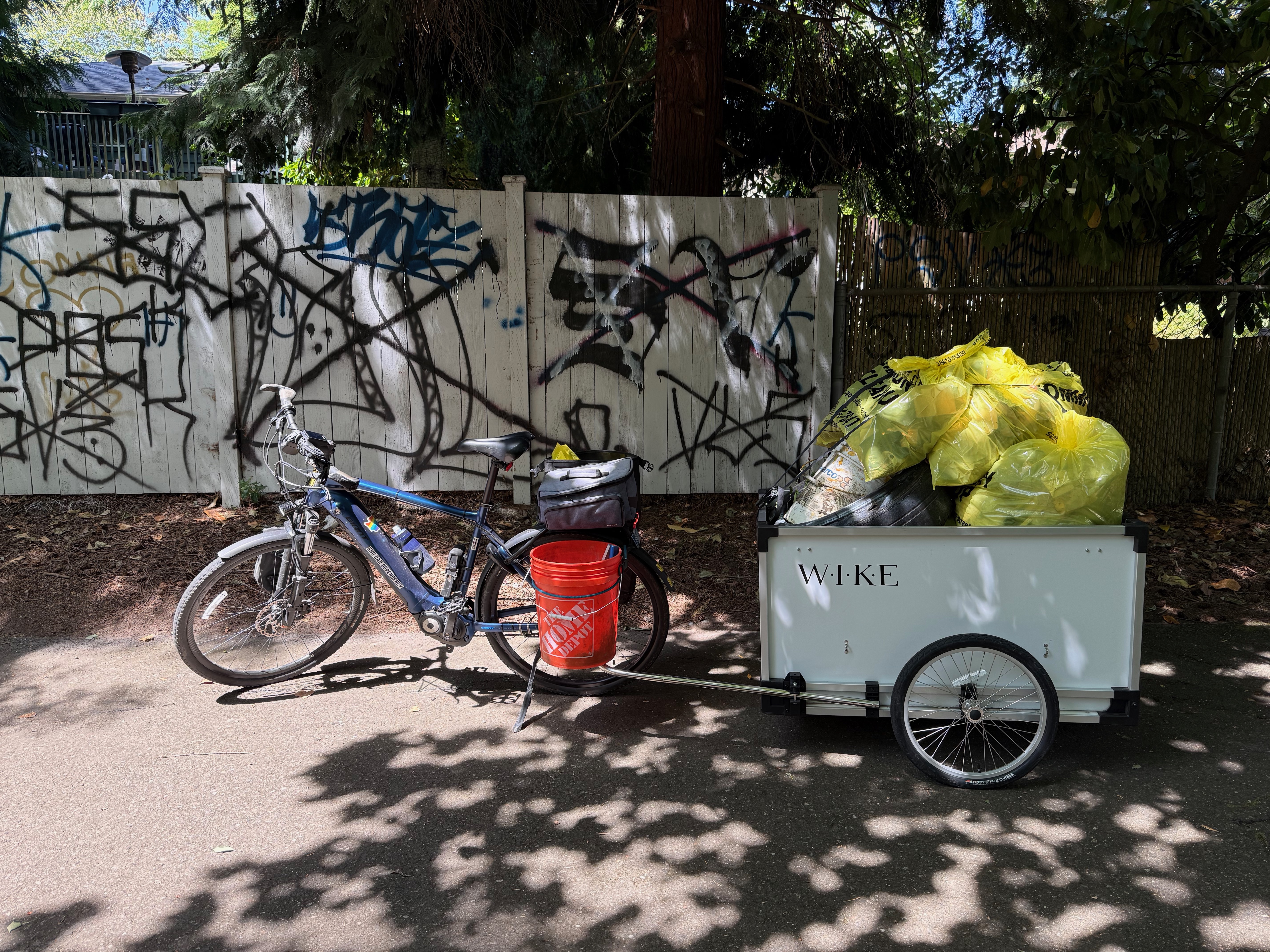
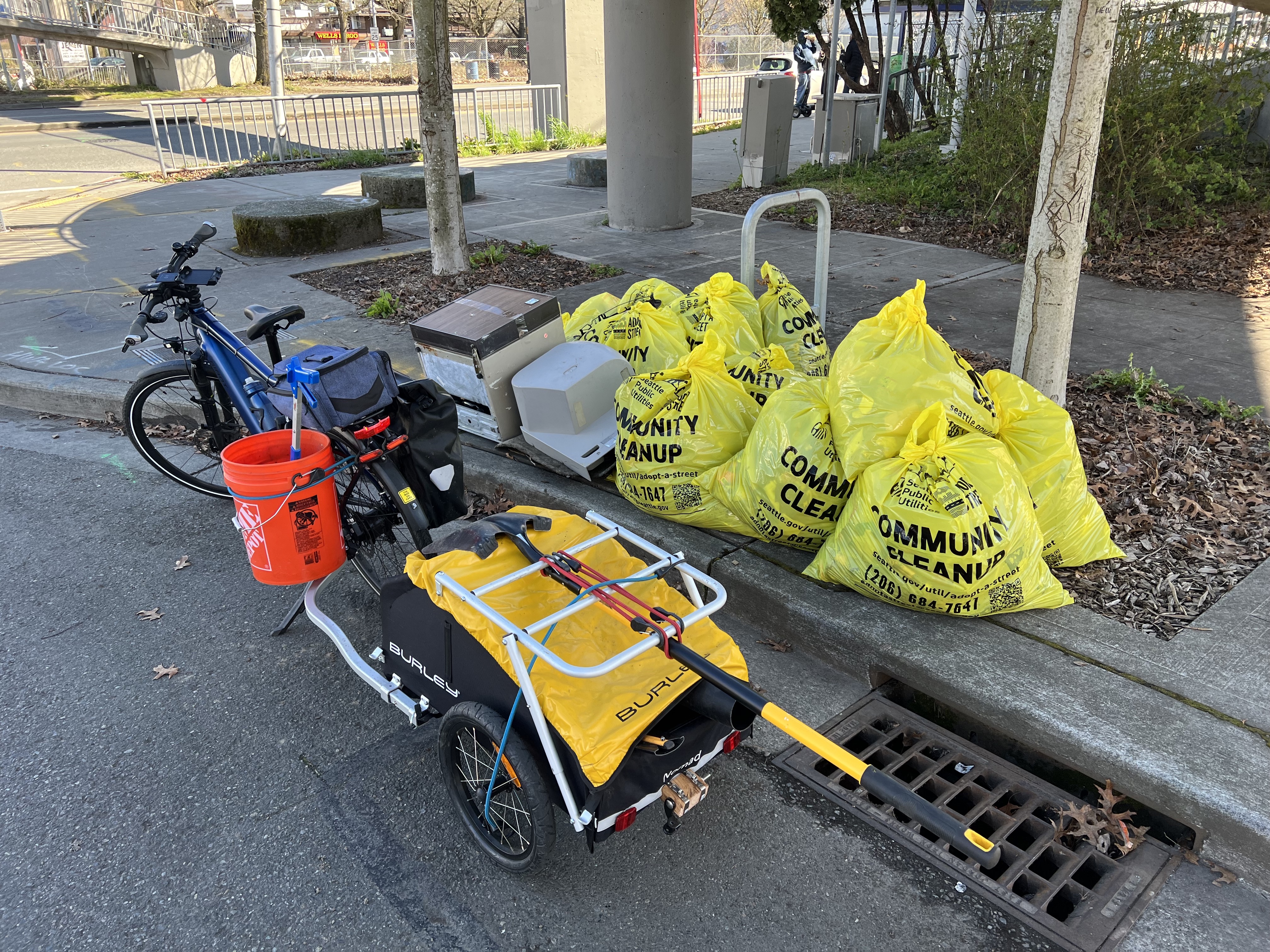
Bike and trailer outfitted for cleanup work with a bucket strapped to the pannier carrier of the bike and the Burley Nomad trailer loaded with tools (not visible) and a flat shovel strapped to the Cargo Rack on its top.

This section is very work-by-bike centric, but most of this advice applies to anyone working by car or otherwise as well. Consider working by bike if you can, though. Sidewalks, bike lanes, trails, and other places are much more accessible by bike, and you can keep your tools and supplies much closer to where you’re working that way. It’s ideal!

Giant Explore E+ e-bike

The bike is by far the most expensive, and most personal component of the rig. I have a 2022 Giant Explore E+ e-bike, and I think it’s a good fit for this purpose. An electric bike of any sort is very helpful (and maybe even required) for getting around Seattle with a trailer loaded with tools or trash.

On any non-cargo bike, you’ll also almost certainly want to have a trunk bag and pannier carriers (or a rear rack). I find that I can strap a 5-gallon bucket to my rear rack very nicely and it doesn’t interfere with the trailer hitch (whereas a pannier on that side does).

I have also modified my bike with a Rohloff Speedhub internal gear hub, partly to have lower gears available for hill climbing with a heavy trailer, but that is certainly not required.

ABUS Pro Tectic 4960 lock

The ABUS Pro Tectic 4960 lock is a good “cafe lock” to quickly lock the rear wheel when you walk away from the bike to keep your bike safe from “grab and go” theft. On a cleanup rig, it’s handy to quickly lock the bike up without anything to lock it to (although a heavy trailer loaded with trash also discourages theft). However, a much more important (and invaluable) use for it is as a parking brake so that you can park the bike and trailer combination on a (reasonable) hill and be able to walk away from it as you pick up litter, and keep it from rolling away as you load the trailer.

Ortlieb Back-Roller waterproof panniers

I have a pair of Ortlieb Back-Roller waterproof panniers, and I keep the right-side one loaded up with various cleanup supplies so it’s usually ready to go. I generally carry the cleanup bags, extra gloves (for myself when I get my gloves wet or gross, and to lend out), a sharps container, extra straps and bungees, any any other small tools. I can also store extra clothing in the pannier, which is handy. They are waterproof so your supplies and clothes don’t get soaked.

Burley Nomad trailer with cargo rack

The Burley Nomad is probably the most versatile trailer for general cleanup work, especially with the Cargo Rack accessory. It is covered so that you can load it loosely with tools and not need to strap anything down inside it, which is great. It’s also nice to keep the rain off the contents, such as batteries and power tools that may not appreciate being left in the pouring rain. The cover may also keep passers-by from pilfering anything inside. The cargo rack accessory provides a nice flat (or angled) area with tubes that are handy to strap down trash bags, tools, and anything else you need to carry. While the Nomad trailer is very handy, its raw carrying capacity for trash and other junk is not that high.

I’ve modified my Nomad trailer so that I can tow the Flatbed trailer behind it, so that I can bring both trailers along.

Burley Flatbed trailer

The Burley Flatbed trailer is great for shuffling large amounts of heavy junk around. I can usually fit three fully loaded trash bags per trip on this trailer, and when correctly balanced, I can easily carry ~200 lbs (just don’t tell Burley, since the weight limit is only 100 lbs). The Flatbed trailer is, however, not great for carrying tools and supplies as you’ll have to strap everything down very carefully and tediously, or you’ll lose things on the street biking across town (ask me how I know).

Mr Tuffy tire liners

I use Mr Tuffy tire liners in my bike tires and all trailer tires. Especially since cleanup work necessarily means going to messy locations, and since Seattle has more than its fair share of road hazards anyway, these will keep you rolling most of the time instead of having to fix flats once a week. Hazards are mainly: broken glass, metal shards, broken-off needle tips, nails and screws, and sometimes thorns.

Gloves

You need comfortable and durable work gloves, possibly waterproof ones. Always use them. Bring several pairs. I use Milwaukee Performance Work Gloves from the selection at Home Depot.

Five gallon bucket

For any litter picking, a bucket is practically a requirement. It’s a huge pain to carry a bag around while picking, it’s awkward to get the trash into the bag, and it will quickly get heavier than you want to carry. You’ll also inevitably drag it across some blackberry brambles and tear a huge hole in it, spilling all the tiny litter you just picked up. Pick the litter into a five-gallon bucket and dump the bucket into the bag each time it’s full. I typically use an orange Home Depot bucket, but I need to get an unbranded one and put some stickers on it.

Garbo Grabber collapsible litter reacher tool

I use the Garbo Grabber collapsible litter reacher (provided for free by SPU) for picking up litter. There are a lot of variations of trash grabbers available for sale, but the Garbo Grabber ones provided for free by SPU are nicer than the ones I bought from Home Depot. Whenever possible, don’t pick up trash by hand. Use a trash grabber. Needles can hide under or inside of trash. (Besides that, it’s often kinda gross, and you’ll want it at arms’ length anyway.)

Sharps container

If you’re litter picking in Seattle, you’re unfortunately absolutely going to find hypodermic needles (with blood and drug residues), razor blades, and other similar sharp things. You can get sharps containers from SPU with your other Adopt-a-Street supplies. If you’re comfortable doing so, I would encourage you to collect them and dispose of them properly to keep kids, dogs, and bike tires from finding them. In general, it’s not a big deal: bring a sharps container along, and use the trash grabber to pick up each needle individually and drop it into your sharps container. Once the container is full, dispose of it properly using the City of Seattle Sharps Collection Program.

If you’re not comfortable doing this, I understand. You can leave them in place, and ideally report them through the Find It Fix It app.

Hand broom and dustpan

A decent interlocking (for storage and keeping track of both parts) hand broom and dustpan is invaluable for cleaning up broken glass on sidewalks and bike paths. You probably don’t want to bring the one you use in the house, so it’s a good idea to get a dedicated one.

Flat square shovel

A flat square shovel is very useful for scraping up things from the sidewalk: mud, moss, etc., as well as sorting through trash on the ground (or even shoveling it up into a bag). I like this DeWalt 49-inch version, but anything you’re happy with works fine.

Rugg Leaf Scoops

A handy tool is the Rugg Leaf Scoops (provided for free by SPU), which allow you to pick up a large quantity of leaf litter for bagging. If you’re doing a substantial amount of leaf cleanup work, a pair of leaf grabbers like these is essential. Many people also find that a snow shovel is quite useful for this task.

DeWalt 60V MAX FlexVolt leaf blower

I have the DeWalt 60V MAX FlexVolt leaf blower and it’s pretty good. This is useful for blowing leaves, of course, but also sticks, seeds, and gravel. I use it a lot, and it almost always comes in handy.

DeWalt 20V MAX 22″ hedge trimmer

I have the DeWalt 20V MAX 22″ hedge trimmer for cutting back blackberries and similar. This is very useful for clearing overgrown sidewalks.

DeWalt 20V MAX reciprocating saw and blades

I have the DeWalt 20V MAX reciprocating saw for cutting trees and branches too large for the hedge trimmer. Usually when clearing overgrown sidewalks we’ll have to break this out at least a few times. It’s also useful for cutting up downed branches (or even entire trees) so that they can be moved. You’ll also need some decent pruning blades for it, such as these Diablo 9-inch pruning blades, but whatever works.

DeWalt 60V batteries

I have 7 of the DeWalt FlexVolt 20V/60V MAX 9.0 Ah battery and carry a few of them as needed in a separate bag. Especially if you intend to use the leaf blower for anything substantial, you’re going to need multiple batteries (each 9 Ah battery lasts about 15 minutes at full power). I got the specific tools that I did to maximize battery sharing; they all use the same batteries.

Collection of bungees and straps

You will need a bunch of bungees and straps to attach everything to the trailers, and to be able to move trash and other junk around efficiently without it falling off. There’s an art to strapping things down and you’ll get the hang of it eventually. I usually carry and use around 7-8 bungees of different lengths, and a couple of Husky 1 in x 8 ft lashing straps. (I’ve found that ratchet straps are too cumbersome to use for this purpose, but they do work.)

GearLight S400 Pro front and rear lights

I use the GearLight S400 Pro front and rear lights in various flashing modes when I have my bike parked on the sidewalk or near the bike path to notify oncoming people that I’m around and working. It also likely notifies potential thieves that I am around and the bike wasn’t just left there.

Find an area in need

I bike around Seattle every day to exercise, explore the city, and as my daily transportation, which means that I end up seeing a lot of areas up close. I’ll often mentally note an area in need to come back to later. When I am out doing one cleanup, I inevitably stumble upon several more. I keep a spreadsheet.

I am not usually looking for massive cleanups, but something where I can make a difference as an individual cleaning up solo, but that’s just me, as I am pre-planning-averse. I focus on areas where accessibility or safety is clearly compromised, or where a problem is likely to escalate. I often work in “less loved” neighborhoods such as SODO and Georgetown. I also try to keep my “home” streets such as Highland Park Way SW clean and accessible.

Find a community (optional, but fun!)

There are a few groups out there doing cleanup work, such as Seattle Street Fixers (@SEAStreetFixers on Twitter). It can be a lot of fun to meet like-minded people and do some work together to make a bigger difference. There are, however, groups which might be doing something in a way that you don’t agree with or doesn’t match your goals. Be sure the group matches your expectations and feel free to bail out of groups that go in a direction you don’t agree with.

Do the cleanup work

I usually start in the morning on weekends, load up the bike and head out to the work area. Upon arrival, park the bike to the side somewhere (but not far away), lock the cafe lock, come up with an overall plan for the day, and set to work. If I am primarily litter-picking I’ll usually walk with a five-gallon bucket in my left hand and trash grabber in my right, picking up as I go and dumping the bucket into bags. I’ll generally leave the bags as they get full (ideally in pairs though). As I walk, I’ll also move bulky items near to the curb/path so I can come back for them easily and not forget about them.

Bike and trailer outfitted for litter collection with a bucket strapped to the pannier holder, a pannier with supplies, and the Burley Flatbed trailer loaded with three large bags of collected litter and other items.

Once I’m done for the day (or sometimes mid-day as well), round up all the bags and other junk at a single collection point (more on that below). I usually shuttle bags and junk in several trips using the bike trailer until everything is rounded up in one place.

Create a pile and report your cleanup for pickup

If you’re working with Seattle Public Utilities Adopt-a-Street program, you can (and should!) report your cleanup on their website.

To make things as easy as possible and ensure a quick pickup, make a single pile of everything you collected, and I’ve found the following formula works well:

  • Do not block the sidewalk, bike lanes, crosswalks, or any other accessible infrastructure!
  • Choose a spot near a major intersection, but not at the intersection. Keep in mind that a potentially large truck will need to stop near the pile and load everything.
  • Place everything at the edge of the roadway so that it’s visible from both sides of the street and can be easily located.
  • Use the bright yellow Adopt-a-Street bags so that they are very visible, place them up front, and make it obvious to the driver that your pile is the one that was reported for Adopt-a-Street pickup.
  • Place everything on public property: planting strips, near tree wells, or on the sidewalk space (if possible without blocking anything).
  • If you must block or impair something, block the roadway rather than the sidewalk.
  • For the sake of cost efficiency in the Adopt-a-Street program, try to create just one pile (the bike trailer is nice for this because it’s really not painful to move things even quite long distances), but don’t kill yourself to do that. Just try not to leave five piles of two bags each for pickup… that will cost the city five times as much.
  • Make sure nothing can blow away: put or other heavy items on top of lighter items such as signs and cardboard.

Don’t forget to take a few pictures, both for the cleanup/pickup report and to tell people about it! (And if there’s any question about the pickup location, you can refer to the location the picture was taken and any landmarks you can see in the photo.)

Here are a few exemplary locations:

A pile of bags and junk left for pickup at one of my typical locations on the planting strip near the intersection of Highland Park Way SW and W Marginal Way SW.
A pile of bags and and junk left for cleanup at the curb on sidewalk and tree well near the intersection of S Winthrop St and Martin Luther King Jr Way S.

Tell people about it!

Write on Twitter, Facebook, Instagram, etc., and tell people about the awesome work you’re doing. It helps to get some encouragement from others, of course, but it also encourages others to get out and help as well. Mention your local Adopt-a-Street agency, tag your city name, and engage with others to encourage engagement. I frequently post on Twitter as @jeremycole about my cleanup efforts around Seattle.

When you see someone, say something… or help!

If you’re out somewhere and see someone cleaning up, feel free to stop by and say “hi”, offer your support, or even offer a helping hand. It’s really great to hear kind words of support. If you’re in a car, don’t honk though, as it’s very startling to a pedestrian, and a car driving at 150% of the speed limit honking in support as they speed by isn’t exactly… encouraging.

I learned to read at 20 years old

[Note: I shared this post on Twitter and there has been a fair bit of discussion about it there. Please feel free to re-share if you find it interesting or you learned something, and I’m happy to answer questions or read your comments there, or in the blog post comments here, as well. Thanks for your support and kind words!]

If you’ve worked with me, read my technical writing, my public Twitter or Facebook posts, or read any of my posts here in the past, you would probably not consider me illiterate. (I hope, hah.) In fact you probably read the title of this post and thought it must be clickbait – but it’s not. It’s true. I was not able to read traditional books or anything else substantial until I was 20 years old.

I am dyslexic. I didn’t know it until adulthood.

In the past two decades I have worked in some exciting and incredible places and accomplished a lot. From small startups in the early days of the web, to being an early employee of and shaping the future of MySQL, moving to Silicon Valley to work at Yahoo!, running my own technical consulting company, expending inordinate blood, sweat, and tears to keep Twitter alive in its pivotal years, working in the heart of the beast at Google, and now helping the world’s entrepreneurs be successful at Shopify – I’ve been around a bit, and I’ve been incredibly lucky to have been given many opportunities to excel.

Disclaimer: This is my story, my situation. It’s deeply personal, of course, but due to human biology, and also human experiences, how dyslexia is experienced and dealt with varies a lot for everyone. Some of this probably applies to nearly everyone who is dyslexic, but no doubt some of it is my own quirks, or just wrong. I don’t really like writing about myself, and some of this is embarrassing to talk about publicly, but I am hopeful that this will help others struggling with dyslexia even if they don’t know it yet.

My insurmountable struggle with school

Growing up, my family moved a lot.

I was never in the same city, and thus the same school system, for more than a handful of years. I barely remember half of the schools I attended. I never had any long term relationships with any school staff or anyone that cared to understand what the reasons for my struggling actually were. Most of my teachers thought I was either lazy or stupid, or gave up on me. I was overweight, and in later years nerdy, and almost always (due to moving a lot) the “weird new kid”. I was bullied relentlessly by other kids.

Starting at a very young age, once I started in school, it was clear that something was wrong with me. I struggled with the most basic subjects in elementary school. I failed at, or failed to complete most of my work. It was a combination of struggling with the material itself (especially anything involving reading or writing), and boredom. I hated pretty much every single minute of school and did everything I could to avoid it. I was once (in third grade?) dragged inside the school–literally kicking and screaming–by the school principal.

I struggled through elementary and middle school, nearly failing several grades along the way. Then came high school, for which I was horribly unprepared, and I quickly realized I was in deep trouble.

Entering ninth grade, I attended a “year round” high school in Kentucky. This school had a quite unusual and somewhat experimental 4 x 90 minute daily schedule, which meant completing four full courses during the first half of the year, and starting an entirely new set of four courses after winter break. I did reasonably well.

Halfway through tenth grade, my family moved again, to another state, to a different school system – one which used a more traditional course schedule. Since we moved mid-year, this meant that I had completed half of my courses, but not yet started the other half, while the students I was joining at the new school were halfway done with all of their courses. Since the new school was in a different state, there were also slightly different credit requirements for graduation… leading to a very unpleasant school year of chaos.

Eleventh grade was a struggle as well, and afterwards, it was clear I was not going to graduate high school on time – I had failed two English courses, for one, so I would end up needing to take 10th, 11th, and 12th grade English all at the same time in my senior year, or repeat the 11th grade. I decided I had had enough. I dropped out of high school and took the GED test (after I moved states, on my own, to another state where it was legal for me to do so) to get a high school equivalent diploma.

I had planned to attend DeVry University and get a degree in Computer Science, but (long story short) it was not what I had hoped for. I struggled with depression (that I only now recognize), and I ended up attending only two semesters at DeVry before leaving and working full time instead. I’ve been working ever since.

Reading is not reading

How did I get all the way to nearly finishing high school–in the United States–while being functionally illiterate? There’s a lot to blame on the American school systems for that, and I won’t get into that here. However, one of the biggest challenges is that: reading is not reading per se.

All throughout school it would be hard to say, at any time, that I “couldn’t read”. I could read the instructions to problems, I could read aloud (mostly), I could read the board (untreated eyesight problems aside), and it would not have necessarily been obvious that, despite all of that, I could not read in the traditional sense: I could not read books, long articles, essays, etc. This meant that most academic knowledge was beyond my reach (and, to be honest, some still is).

It turns out that being “able to read” is not a singular thing where you either can or can’t – where you’re either literate or illiterate. It’s always been easy for me to read short passages, single sentences, instructions, short word problems, etc., but it was impossible for me to read books, long paragraphs, or anything really longer than half a page or so.

Writing is not writing, either. Throughout school, I really struggled with handwriting, producing only incredibly messy scribble with letters out of order, or backwards, and without space between words. To this day, unless I really concentrate on writing neatly, it’s the same.

I also struggled with math in school… especially with showing my work, rather than with understanding the math. I could not write well, but I innately understood the problems and the math behind them. I tended towards doing calculations entirely in my head, or writing scribbled “notes” (to offload my short term memory) rather than full solutions. I often used non-traditional ways of working out problems. (This is still how I do a lot of math.)

I learned that there is nothing that irritates an American math teacher more than not showing your work in the way they want you to. It doesn’t matter if you get the right answer. It didn’t matter whether I was excited about learning it.

Through much of my school years I mostly believed my teachers: I must be really lazy, or stupid. Something must be wrong with me.

A fortuitous parallel thread in my life: computers

As you are probably aware by now (or if you know me at all), I got involved in computers very early in my life, as well as (luckily) fairly early in the life of computing itself. I was 8 years old when we got my first computer in 1989: a yard sale IBM PCjr for $100, ostensibly for the family. When we got it, it was already quite outdated and limited (having been sold new about five years earlier). It came with IBM PC DOS (of course), cartridge BASIC, and most critically, the whole collection of original manuals.

Computer, operating system, and programming language documentation is somewhat unique: It tends to be composed of small fragments, each describing a single device, program, command, function, etc. Reading them, I realized very quickly that I could read just fine, and comprehend them. (In fact, I really understood them very well even for my age, and could visualize the way things worked spatially–due to dyslexia–but I didn’t know that yet.) Using the results of what I learned from those manuals, I also discovered that I really enjoyed making the computer do what I wanted.

Having full-time access to a computer for the first time, I realized that when I typed something the computer would make the symbols I wanted in the right order, and the right way around, with no effort, and I could easily edit what I had typed to fix letter swaps and typos. It didn’t take any of my mental energy to remember the right shapes or orientation for the letters or any of my patience to make myself draw them. It didn’t sap all of my confidence trying to write something and messing it up over and over. I didn’t realize it at the time, but this was life changing.

From that moment on, I’ve never stopped using and learning about computers.

The Gift of Dyslexia

About 18 years ago–I’m not entirely sure how or why–I read something about dyslexia in an article or on a web site. I had heard about dyslexia before, of course, but had a perception of it as a learning disability – something they talk about in school, but surely not something I had. After all, I was 20 years old, successfully working with computers, reading documentation, writing a thousand-page manual for MySQL, reading and writing emails every day…

I did some quick research, and on May 4, 2002, on a whim, I bought a book from Amazon that would change my entire perception of myself, and completely change the last 18 years of my life since then: The Gift of Dyslexia: Why Some of the Smartest People Can’t Read… and How They Can Learn (now available as a second edition) by Ronald D. Davis.

In The Gift of Dyslexia, Mr. Davis explains some of the workings of the dyslexic mind: the learning “disability” parts of course, but also the distinct advantages that come with it, primarily exceptional spatial reasoning and automatic three-dimensional visualization. In his description in Chapter 1, The Underlying Talent, Mr. Davis says:

The mental function that causes dyslexia is a gift in the truest sense of the word: a natural ability, a talent. It is something special that enhances the individual.

Dyslexics don’t all develop the same gifts, but they do have certain mental functions in common. Here are the basic abilities all dyslexics share:

  1. They can utilize the brain’s ability to alter and create perceptions (the primary ability).
  2. They are highly aware of the environment.
  3. They are more curious than average.
  4. They think mainly in pictures instead of words.
  5. They are highly intuitive and insightful.
  6. They think and perceive multidimensionally (using all the senses).
  7. They can experience thought as reality.
  8. They have vivid imaginations.

These eight basic abilities, if not suppressed, invalidated, or destroyed by parents or the educational process, will result in two characteristics: higher-than-normal intelligence and extraordinary creative abilities. From these the true gift of dyslexia can emerge–the gift of mastery.

I realized quickly that I saw in myself a lot of the advantages of dyslexia, and I immediately recognized the challenges as well. The book goes on to describe several methods to overcome most of the reading challenges associated with dyslexia. It’s not perfect, and I didn’t follow all of its advice, but it set me on a definite path to conquer my own dyslexic reading problems, as well as to understand and embrace the advantages it brought me.

At the time, I was traveling full time for work, flying all over the world, and during that travel I read a lot of basically trash material, as practice. In particular, I read the entire series of John Grisham novels because they were formatted well for me (see below for more on that), they were easy reads, perhaps most importantly they were readily available at every airport book shop so I could pick up a new one after finishing each one. I had to consciously work to apply the methods I learned and make it through these books, but it trained enough of my brain well enough, so that I could read other more difficult material more easily.

Finally, at 20 years old, I learned to read.

What is/was dyslexia like for me?

Before re-learning to read (and even now, if I am tired or too distracted), trying to read a page of text was a challenge: The letters are a jumble. The words are scrambled. I subconsciously read the words in the adjacent lines of text as I am reading. I jump ahead or re-read behind. I read parts of the opposite page. My imagination spins with ideas about what I read. By the time I get to the end of a paragraph, I have no idea what I’ve just read, so I have to read it again. And again. And again.

Aside from the most obvious problems with reading (which I’ve largely overcome), I have many ongoing struggles:

  • My handwriting is atrocious. Unless I am very careful (slow) and methodical, letters will be poorly spaced, mis-ordered, and otherwise pretty unreadable.
  • I can’t take good notes. Since I cannot write by hand quickly enough, or listen and/or think at the same time, handwritten notes are pretty much impossible. I can type to take notes, but that makes the kinds of quick annotations and illustrations that good note-takers usually do very hard.
  • My memory is poor. This is not because of an actual lack of memory, per se, but rather the mechanism by which I form memories. It is more physical and spatial than most. If you just tell me something, it’s gone instantly. I cannot remember singular facts without context. That includes dates, names, amounts, addresses… pretty much anything.
  • I have no sense of order. I will mix up anything that can be flipped or is ambiguous, such as left/right, north/south, east/west, function parameters in programming… the arguments to ln. It doesn’t matter how recently I’ve been told or how recently I’ve used that information.
  • I have no sense of direction. My wife will attest that no matter how many times I’ve been somewhere, or how easy it is to get there, I will get lost. This is mostly because of the previous point about my sense of order.

In re-learning to read, I realized that there are several important factors that go into reading successfully. For me, these are the most important things to understand:

  1. I must always carefully choose the physical layout of the material. The choice of font (and size), and the way a book is typeset, including the size of the margins are all important. Using an e-Reader such as Amazon Kindle helps enormously with this, as for most content I am able to choose the layout features myself. For physical books, I can glance at a few pages and quickly tell if I’ll be able to read it or not. As for me:
    • I prefer simple sans serif fonts without much decoration and with clear letter shapes.
    • I tend towards larger font sizes, as it minimizes distraction from adjacent letters/lines. Tiny text on wide pages is the worst.
    • Perhaps most importantly: Any longer text must be full justified. I find the ragged edges on the right side of a page of left justified text to be so distracting that my reading speed is less than half and I will struggle to get through anything substantial. I realize some people hate full justify, and I’m sorry.
  2. I have to evaluate the writing style of the author. This is a bit harder to describe, and varies a lot by the subject of the material. In general though, for me:
    • I avoid unnecessarily flowery writing styles. Beautiful descriptions of scenes that don’t directly apply to what is happening distract me greatly and I will get lost.
    • A well laid out logical explanation from top-down is usually best. If the author gets mired in the low-level details too early or too often, I will get lost.
    • Illustrations, especially high level or architectural ones help me “set the scene” so that my brain isn’t spending time creating potentially wrong visualizations as I read.
    • Starting with a clear overview or background of what I’m about to read, with definitions, helps a lot.
    • Keeping each paragraph reasonably-sized and on topic helps. Many really short paragraphs (like one sentence) back to back are hard for me to read. Really long paragraphs are impossible for me to read – I get lost in the sea of words.
  3. I always “read aloud” in my mind. For me there is no difference really between reading aloud and reading to myself, except for vocalizing what I am reading. I have the same internal monologue either way, and for me, it’s the only way I can read. (I know this differs with different dyslexics.) This also means that my reading speed is approximately the same (slow) either way.
  4. I use my “mind’s eye” to read. In The Gift of Dyslexia, the author describes fixing in place your “mind’s eye” (the point from which you visualize things) and not letting it wander. This is true for me, and I have to consciously choose to do this while reading text, rather than allowing my mind (and thus my eyes) to wander around the page as it normally would. Imagine my reading as like following the “ball” in karaoke. This is the part that fails first when I am too tired while trying to read.
  5. It’s critical for me to avoid distractions and noise. Until reading The Gift of Dyslexia I really didn’t understand how much simple distractions actually affected me, but they do. I frequently use noise-canceling headphones even without any music playing, just to eliminate the normal house or office noise.

When writing (typing, of course): All of the above applies, but I also have to re-read my writing many times, at least dozens. That’s why it may seem polished to you, the reader. I can’t always write well immediately, but after reading and revising so many times, it probably reads well.

When reviewing someone else’s writing: I will usually take a “style” pass to fix up the spacing, style, typos, font choices, etc., before reviewing. This is not because I’m OCD about style (although I am, as well) but rather that I literally cannot comprehend the content of the writing until I’ve first made it consumable to me. I have to fix those things, or I will trip over them so badly that my reading comprehension of the actual content can be zero. This is a “me” problem, not a you problem.

My dyslexic advantages

I’ve described all of the challenges of being dyslexic, but there are also many advantages.

One of the key things I understood after reading The Gift of Dyslexia and doing subsequent research on dyslexia in general is that the reading challenges associated with dyslexia largely stem from differences in the way the dyslexic person’s brain works. These differences produce many challenges with traditional school especially around reading and writing, but they are fundamentally a beneficial difference for many other aspects of life. So I’ll describe what I see as my “dyslexic advantages”; these are subjective based on my own experience, as I can’t feel or understand how other people’s brains work. For me, though:

  • I visualize in three dimensions. This is the thing that causes so much trouble with reading, because it’s automatic and sometimes uncontrollable, but it’s a very useful skill to have, otherwise. I innately visualize my entire life a lot like a CAD model and mentally rotate objects to see them from other angles. At a glance, I can immediately understand how parts can be joined together, how to assemble or disassemble things, what might be inside a component, etc. This is based partly on imagination, thus it’s not always correct, but it’s largely automatic and effortless.
  • I understand connections. I have an innate sense of the interconnectedness and flow of different systems or components. This applies to computer hardware, electrical systems, plumbing, software, and pretty much any other system. I can sense both how things work and how they or their connections or dependencies can fail. (This does not always extend to making small engines run, though.)
  • I sense correlations. If you’ve worked with me digging through graphs trying to find the source of some bad database traffic, you’ve probably sensed this. I often can’t explain it, but I have an (sometimes almost supernatural) ability to look at a handful of graphs and mentally sort through the noise and figure out causes vs. effects vs. bystanders.

These dyslexic advantages have proven very useful in my professional career working as a computer programmer or working on databases in various web or similar companies. They allow me to understand complex software and systems architectures very easily. I have a good idea how to successfully assemble new systems. In my hobbies and spare time they have allowed me to build very complex devices and electronics for personal projects, to help kids build robots, and to learn to fly airplanes.

Why am I sharing this? Why now?

Through my childhood and my young adult life I was both unaware of my challenges (and dyslexia itself), and ashamed/embarrassed of what those meant. In the intervening years as I came to fully understand my dyslexia and embrace it, I have talked to some people about it, but not very many. To be honest, I am still somewhat embarrassed by it.

Because I could never read during the formative years of my young life, I didn’t read any of the usual books that people generally read. I never developed any love of reading for “fun” as opposed to learning by reading. Even now I don’t really read fiction, I read non-fiction about politics, biographies, and technical topics.

I know there are millions of kids struggling in the same way that I did, without any sort of support network for them. I hope that sharing my story helps at least one struggling child, or helps a parent, teacher, or mentor understand what might be happening. Or… maybe you’re another adult reading this, and it triggers a flash of realization for you.