
So you want to run a group ride?
Group bike rides are one of the most fun ways to explore a city with your friends, or just to spend a few hours or a day out. Joining organized group rides such as Critical Mass in your city is a great way to meet like-minded people and see new parts of the city. But… how do you get dozens or hundreds of people around safely? The main threats in a group bike ride are:
- Cars. There is no question, cars and their drivers pose the most risk to everyone getting home safely. Most of this post covers how to keep the ride safe from cars and how to safely navigate wide streets and large intersections.
- Environment. Potholes, curbs, puddles, overhanging vegetation, bollards, poles, broken glass, etc., everything is out to get you. Communication is key.
- Riders. Try not to run into each other, and communicate clearly where you’re going. Don’t assume someone knows you’re there.
- Bikes. Riders may get flat tires, break a chain, drop a chain, get a strap caught in a cassette, fail to clip out, and any number of other bike-related problems. Be prepared for the basics, communicate dangers, and be ready to help when someone gets in trouble.
I’ve ridden with group rides from just a few people up to thousands, in several different cities and countries, and there are a few things that help any ride run smoothly, and dangers in common. Whether you’re leading a group ride or just want to join one, hopefully this post provides some useful information for you.
Overview
- Come up with a cool idea for a group ride; not too long, but also not too short, appropriate to the riders’ skill level and strength, and interesting.
- Ensure you have sufficient facilitators for the quantity of riders expected and that facilitators understand and correctly perform their roles.
- Decide what kind of ride you want, considering the number of riders: bike facilities only, single lane only, or full takeover. (See definitions and examples below.)
- Have a ride leader: a single distinctive, bold, and well-prepared leader to set the direction and pace, keep the group together, and direct other facilitators.
- Have corkers: a number of riders that control traffic effectively and keep cars from presenting unsafe situations.
- Have a caboose/sweeper: a rider that marks the end of the group, and ensures no one is left behind.
- Have communication: use radios or another real-time communication mechanism between the ride facilitators to communicate the position of the caboose/sweeper, any problems (such as mechanicals) and any dangers (such as aggressive car drivers).
Facilitator roles in a group ride
Let’s take a look at the different roles in a group ride. Some should always exist, such as leader, while others may be optional.
Leader
- Be the single leader who is in charge, knows the route, and makes decisions (sometimes on-the-fly) about where to take the group.
- Maintain a reasonable/slow speed to not stretch the group out too much, usually 8-10 mph (“party pace”); slower if there are hills or inexperienced riders.
- Don’t lead the group ahead of corkers; let them get in place ahead of you when possible, and ensure that traffic is controlled at each intersection before proceeding.
- Communicate to the corkers and first few layers of the group by making a few callouts:
- Expectations: “rolling after these three cars from the left”, “stopping to regroup”, etc. so that those riders can make callouts to those behind, and so they don’t make confusing callouts (such as misinterpreting a corker getting into place and calling out “right turn” when the group is going straight) or even misunderstand and go the wrong way.
- Actions: “rolling”, “stopping”, “slowing”, etc.
- Directions: “left turn”, “right turn”, “straight ahead”, “hard right”, “left turn into the bike lane”, etc.
- Needs: “someone cork the left side”, “help with that car ahead”, etc.
- Dangers: car, pedestrian, bollard, hole, gravel, curb, etc.
- If a planned turn is missed, don’t panic! It’s probably not safe to make “small” maneuvers to correct back, as a large group has a lot of inertia. Instead it usually makes more sense to take the whole group through a parking lot or around a block, eventually re-joining the route where possible. If a U-turn is necessary, ensure there is enough space to get the whole group into a safe position, and encourage everyone to follow the leader rather than shortcutting the U-turn.
Corker/Marshall
- Corking is often a volunteer role at the time of the ride, and some people may choose to cork only some of the time.
- Anyone can cork at any time, and people should be encouraged to cork if they see anything that may present a safety issue for the ride (for instance, a previously unoccupied car that a driver gets in and intends to pull out into the street).
- Control (primarily) car traffic ahead of, and through the ride, to keep cars from entering, crossing, or endangering the ride.
- It may be necessary to control bike or pedestrian traffic at busy intersections. Since they are humans you’re face to face with, be polite and communicate what you’re doing, and set expectations for how long you will take.
- At least 2-3 corkers are needed for most groups; for larger groups and/or larger intersections, 10 or more could be needed.
- Corkers should normally stay in place until the caboose passes, and if desired, ride fast and catch back up to the leader and continue corking at another spot.
- It may be necessary to help out the caboose to provide some “mass” at the rear if they are being harassed or intimidated by cars behind the ride.
- Ask for help from other corkers and riders if a situation becomes unsafe or uncomfortable to provide more mass.
- Ask for help from other corkers and riders if you notice that cars/movements are uncontrolled (e.g. a traffic lane that was left uncorked inadvertently).
Patch/Medic
- A person familiar with bikes and typical problems and repairs and/or first aid, a quick thinker and willing to jump in to help with any problem. (Any individual could be a patch, medic, or both. Often they are bike mechanics or people who have taken first aid classes.)
- Carry tools, possibly some spare parts, first aid kit, snacks, water, etc.
- Help with any problems (“mechanicals”) riders encounter and get the ride rolling again as soon and as safely as possible.
- The most common problem is a flat tire due to a puncture, so the most basic thing to carry is inner tube patches or spare tubes, a bike pump, and some basic tools.
Sweeper/Caboose
- Stay at the back of the ride and represent the official “end” of the group.
- Don’t leave anyone behind unless they ask to be left (and really mean it).
- Signal or communicate to the corkers as you go by (and/or be distinctive enough for them to immediately recognize you) to release them from corking.
- Block or recruit others to block cars from attempting to pass the ride unsafely in the center turning lane or oncoming traffic lane to defend the riders ahead.
- If radios or other communication devices are used, communicate the position of the end of the ride to the leader, ask for delay or slower pace, and communicate any problems or stalls.
Rider
- Have fun! Don’t worry about the mechanics of a group ride too much.
- Bring the very basics of self-support: headlight and tail light if the ride (or your ride to/from it) will be after dark, spare tube, tools appropriate to your bike, pump, water, etc., and bring a transit card/pass as a backup way to get home.
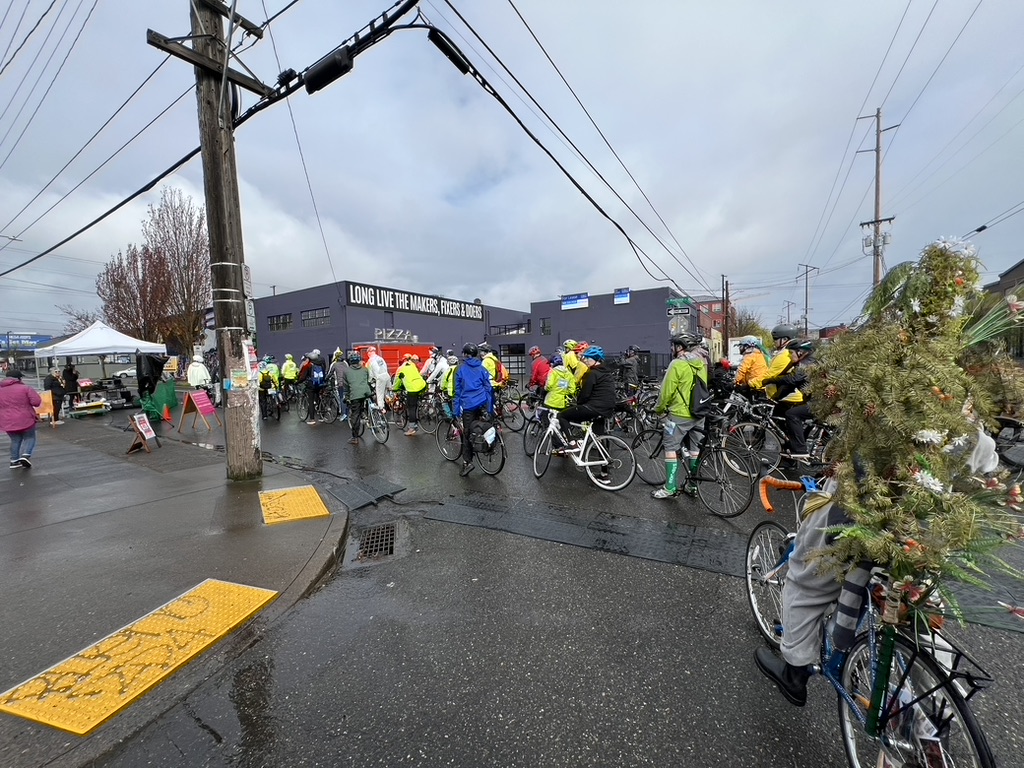
- Play music. Dress up. Decorate your bike. Have a ton of lights. Be yourself.
- Follow directions and keep rolling unless the leader stops or says to stop.
- Don’t ride in front of the leader or behind the caboose. If you do, you’re no longer part of the ride and you’re on your own.
- Communicate your intentions (on your left, on your right, slowing, stopping, ding your bell, etc.) to the other riders near you. Don’t surprise anyone.
- Call out and/or point out dangers to fellow riders, such as bollards, holes, gravel, curbs, etc.
- Repeat messages and warnings to riders behind/ahead of you.
- Keep an eye on your fellow riders and their bikes, let them know of anything unsafe or developing, such as a strap hanging in their wheel, tire going flat, items dropped, cars, car doors, etc.
- Ride safely. Ride dangerously. Ride boldly.
Call-and-repeat messages (callouts)
As the ride proceeds, the riders and facilitators must communicate constantly. There are a number of things that can be called out such as “car back” or “bike up”. Each of these messages should be repeated by riders (using their own discretion) to ensure the message is passed forward/backward through the group. Anyone with radios should also make the same call over the radio as appropriate.
Defining positions in callouts
up: ahead of the ride, approaching from ahead (moving or stationary)
back: behind the ride, approaching from behind
right/left: relative to the path of the ride (or ride leader) not necessarily the person calling
Specific callouts
car [up/back]
A car is approaching (or being approached) from ahead or behind in a way that riders should be aware of.
Typically “car up” calls alert riders to stay on the correct side of the road, and to be more careful with any shenanigans such as wheelies.
Typically “car back” calls alert riders that a car is passing the group, either in the opposite direction lane, or in an open lane. A “car back” call could be urgent if the car is acting very aggressively towards the group, speeding to pass, etc.
Sometimes it’s helpful to call “car back, passing” to let the riders ahead know that the car is already passing and approaching them.
bike [up/back]
Same basic idea as a car, but a bike. For “bike up”, mostly a heads up for nobody to run into a bike in the opposite direction (or slowly riding in the same direction). For “bike back” mostly to be aware that they might be passing. Sometimes helpful to call “bike back, passing”.
It can be helpful to say “bike up, on the right”, for instance, if the position of the bike is unexpected or otherwise helpful to other riders to know.
pedestrian/ped up
A pedestrian is ahead, and typically the group should try to yield some space to them to get where they are going (such as crossing the street), or at minimum avoid hitting them. Often it’s useful to say “ped up, on the right” or “ped up, on the left” or even “ped up, both sides”; pedestrians are wily creatures.
broken/together
It’s common in some group rides, especially when not using corking to manage traffic and proceed through intersections at a group to call out when the group is split. Call “broken” whenever the ride is split, usually by a traffic signal. Call “together” when the group is all back together. The ride leader will sometimes wait in a safe place to regroup after a “broken” call, unless it was discussed beforehand that there would be designated regroup points.
mass up
In large rides, especially Critical Mass, a call of “mass up” requests for the front of the group to slow down and allow the group to gather more tightly together.
mechanical
Sometimes described as an “emergency stop” – after a “mechanical” is called, the ride leader will make a decision to “pull over” the ride in a safe place. Individual riders should not pull over on their own, instead just following the ride leader after making sure that they have gotten the message.
Planning a successful and safe route
- Use a route planning tool such as Ride with GPS to put together a safe route and use a device to follow the route on the actual ride. Google Maps and Apple Maps are not suitable for route planning or for use during the ride because they will readily re-route you during the ride, which may send the group on an untested and unintended (and often unsafe) route. (They can still be used to supplement an appropriate route planning tool.)
- A few days before the planned ride, pre-ride the route with similar conditions as there will be on the actual ride: ideally on a bike, with a small group, at a similar pace, at a similar time of day, if possible on the same day of the week. This helps avoid surprises during the ride such as hills that are too steep, traffic that is unsafe, unexpected lighting issues, etc.
- When the ride uses busy roads with more car traffic, it can be useful to include a pressure relief in the plan. Take the ride on a U-turn on a side street, or turn off the busy street for one block and back on it, loop through a parking lot, or even a make a brief stop on a large shoulder or parking lane. It’s better to be creative and include something fun and less obviously for pleasing car drivers, such as making a quick loop through a nice park near the intended route… then car pressure from behind is relieved, and the riders are just having fun.
- When the ride crosses streets, try to ensure good visibility by crossing in a relatively flat/straight section away from bends and hill crests that limit visibility.
- When crossing at an intersection in the lane, press the pedestrian crossing button, which often gives the signal phase more time than if it’s signaled only for cars.
- Avoid left turns from busy roads (especially multi-lane roads), especially without a good number of well-prepared corkers. Left turns that are yield-only are some of the worst.
Strategies for how and where to ride
Bike infrastructure only
Strategy
- Use only bike lanes, paths/trails, and pedestrian infrastructure (as allowed/safe).
- Sometimes use Single lane only strategy where no bike infrastructure exists.
Pro
- Least likely to draw negative attention from drivers or police (but still, it turns out, not zero).
- With small groups, this strategy can make for a more relaxed ride.
Con
- Bike infrastructure as designed in the US is not suitable for moving a large number of bikes as a group. The signal timings in any intersection will break the group into many small groups.
- Stopping and starting the group rolling at each intersection takes a lot of time.
- Regrouping once the group has been split up (broken) will take significant time and only allow the group to move at a very slow pace (something like 1-3 mph average) spending most of the time waiting to regroup.
- Uncomfortable for riders who are left as the “leader” in the front of a sub-group when the group gets inadvertently split up.
- Riders may be inclined to perform unsafe or illegal maneuvers to avoid being left behind, such as running a red light or stop sign as a single rider, without any traffic management.
- Other users of bicycle and pedestrian facilities may be blocked by or unable to navigate through or across the group, or may be tempted to do so unsafely.
Single lane only
Strategy
- Occupy a single traffic lane and act as one big vehicle or train.
- Sometimes use Full takeover strategy if an area or intersection is too unsafe to guide the group through with mixed traffic (e.g. to make a left turn), or if a situation becomes unsafe.
Pro
- Fewer (but not zero) conflicts with car drivers than a full takeover.
- Less likely (but not zero) to draw negative police attention.
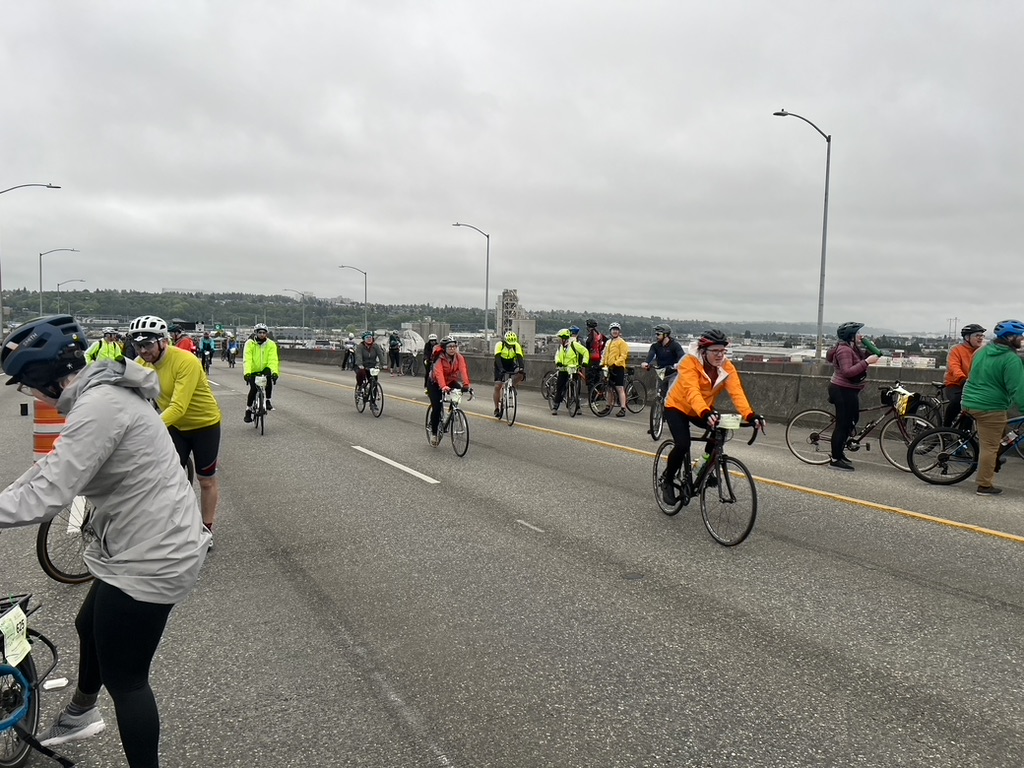
- A full traffic lane packed with bikes (4-5 wide when stopped) fits a lot of bikes in a small space and allows effective movement through intersections given car traffic signal timings.
Con
- It can be very difficult to safely change lanes with the group, e.g. to turn left from a multi-lane road. Strategies exist but require good coordination between the leader at the front and the sweeper at the back.
- Some car drivers will still be upset, especially when a right turn on red is blocked by the group.
- Without corking, if the group doesn’t make it through an intersection in a single signal, the group will be broken up, and then mixed into traffic in a very dangerous way. (Consider asking the group to continue through each intersection as a group.)
Full takeover
Strategy
- Occupy all lanes in the direction of travel to prevent cars from passing or mixing with the group.
- Occupy the center turning lane when present to keep cars from passing unsafely.
- Occupy the curb parking lane when present to keep cars from passing unsafely.
- Occupy the opposite direction lane when there is no separation (e.g. a median) and there are no oncoming cars to keep cars from passing unsafely.
- Cork every intersection ahead of the group and keep them corked until the group passes through (the caboose should release the corkers explicitly).
Pro
- The safest option for large groups (especially 100+) to move efficiently and safely.
- Corking is very clear and unambiguous: all conflicting cars stop for the group to pass through.
Con
- Requires many corkers, especially if large or complex intersections (e.g. freeway offramps) are traversed. (However if this is the case, you should definitely really consider using this strategy for safety reasons, anyway.)
- Causes the most conflicts with car drivers.
- Likely to draw police attention and possible attempts to disburse the group, and in the worst case arrests.
Legality
Laws and the enforcement thereof vary from place to place. In Seattle, large group rides are quite common, and in recent years are subject to almost no police interference or enforcement. In other locations, you could see anything from no interference to an almost immediate police presence and possible arrest of participants.
Examples from Seattle
Critical Mass Seattle
- Protest ride, intended to draw attention and disrupt
- Size: Up to ~250
- Strategy: Full takeover
- Planning: Start point known, but no planned route
- Roles:
- Leader – sometimes informal, often without pre-planned route
- Corker – informal, directed on-the-fly by leader or by own initiative
- Patch/Medic – usually informal
- Sweeper/Caboose – sometimes semi-formal, sometimes none
- Rider – informal, join and leave as desired
- Communication: Radios handed out to a few key people before the ride
Seattle Bike Disco
- Fun ride, intended to be joyful and minimally disruptive
- Size: Up to ~250
- Strategy:
- Single lane only (usually)
- Full takeover (sometimes)
- Planning: Pre-planned route, pre-ridden, all facilitators have route.
- Roles:
- Leader – always formal, with researched and tested route
- Corker – informal, directed on-the-fly by leader or by own initiative
- Patch/Medic – usually formal, announced pre-ride
- Sweeper/Caboose – usually formal, with route knowledge
- Rider – informal, join and leave as desired
- Communication: Radios brought by ride facilitators
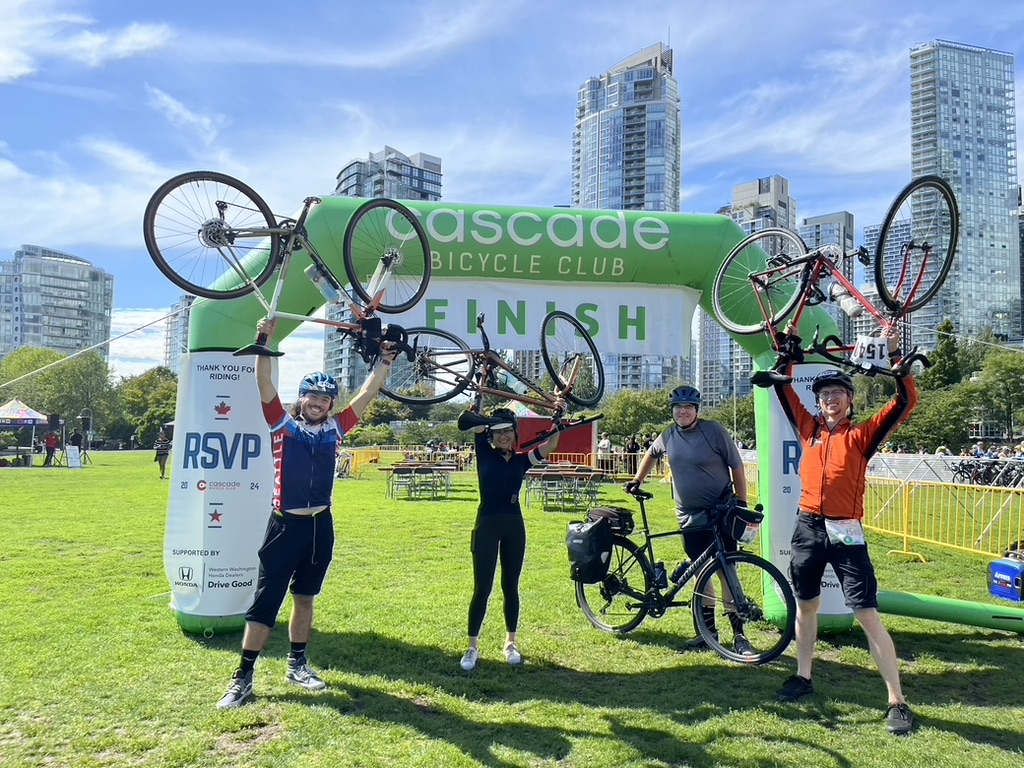
Cascade Bicycle Club (free group rides)
- Group rides for tours, education, or fitness
- Size: Up to ~25
- Strategy:
- Bike facilities only (usually)
- Single lane only (sometimes)
- Planning: Pre-planned route, usually pre-ridden, shared with all riders
- Roles:
- Leader – always formal, with researched and tested route, educational and certification process for ride leaders
- Corker – usually not used due to strategy, sometimes not allowed
- Patch/Medic – sometimes none, sometimes the Leader, sometimes formal
- Sweeper/Caboose – usually formal, with route knowledge
- Rider – usually formal, pre-ride signup
- Communication: Usually voice, relatively small groups












 Jeremy Cole